A great business idea can open a door. Funding can provide the resources to get started. But building a sustainable business requires something more: the practical knowledge to turn ideas and resources into results.
Project overview
Koppoh originally set out to help entrepreneurs access funding through its fundraising platform, Koppoh Fundraising. But the business recognised that access to capital was only part of the challenge. Entrepreneurs could have promising ideas and even secure the resources they needed, yet still struggle to execute, manage, and grow their businesses because they lacked practical business knowledge.
I think of this as “knowledge debt”: the gap that accumulates when entrepreneurs have the ambition and resources to build but lack the knowledge and practical guidance needed to make sound business decisions and execute effectively.
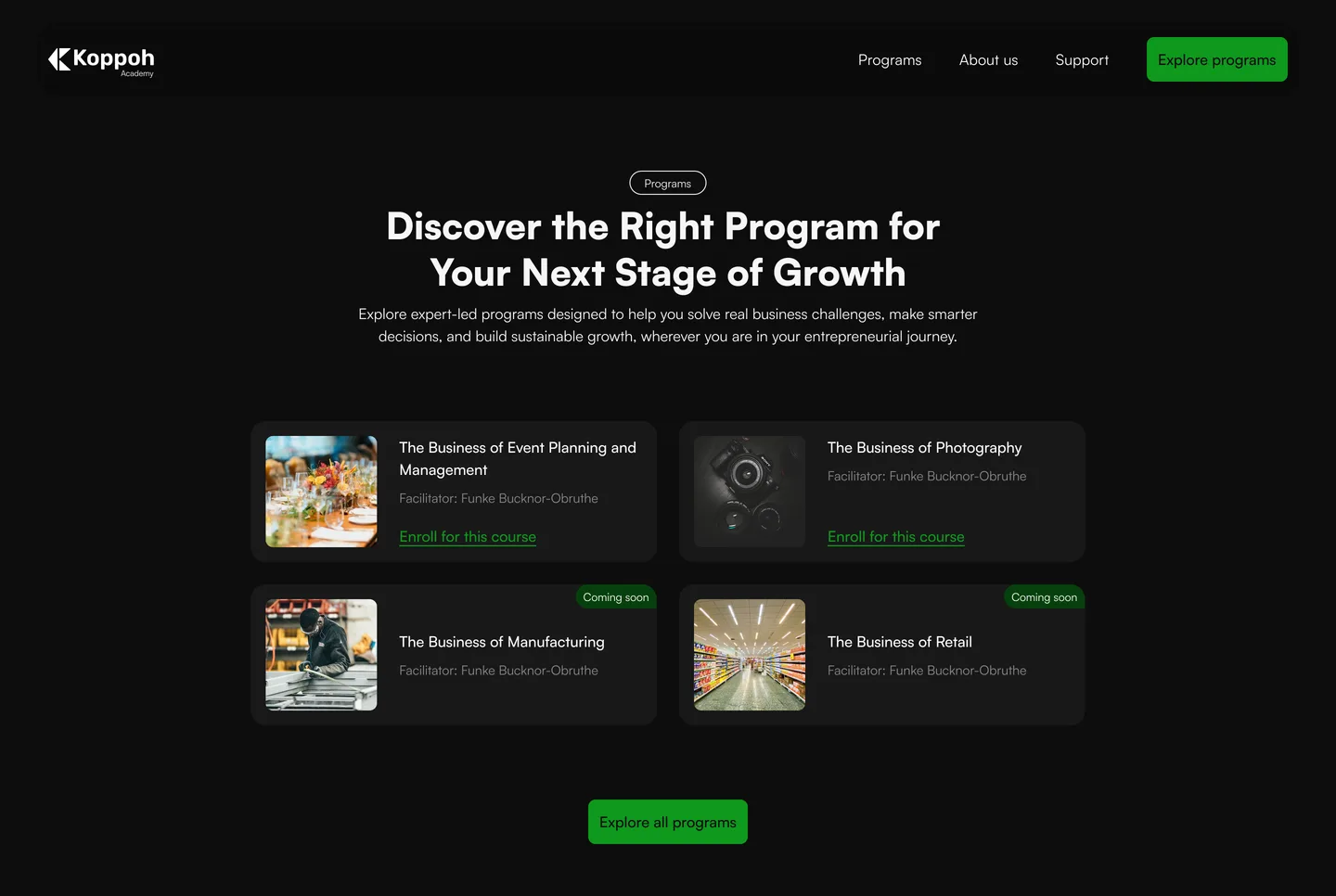
Koppoh responded by expanding its mission beyond fundraising. It introduced Koppoh Academy, a entrepreneur education platform designed to connect entrepreneurs with people who had successfully built businesses and developed real-world expertise in their industries.
The opportunity was not simply to put educational content online. It was to create a learning experience that made expert knowledge accessible, gave learners a clear path through their programmes, and supported them from enrolment to assessment and certification.
As the Product Designer, I designed the end-to-end learner experience, translating the business direction into a structured digital learning journey.
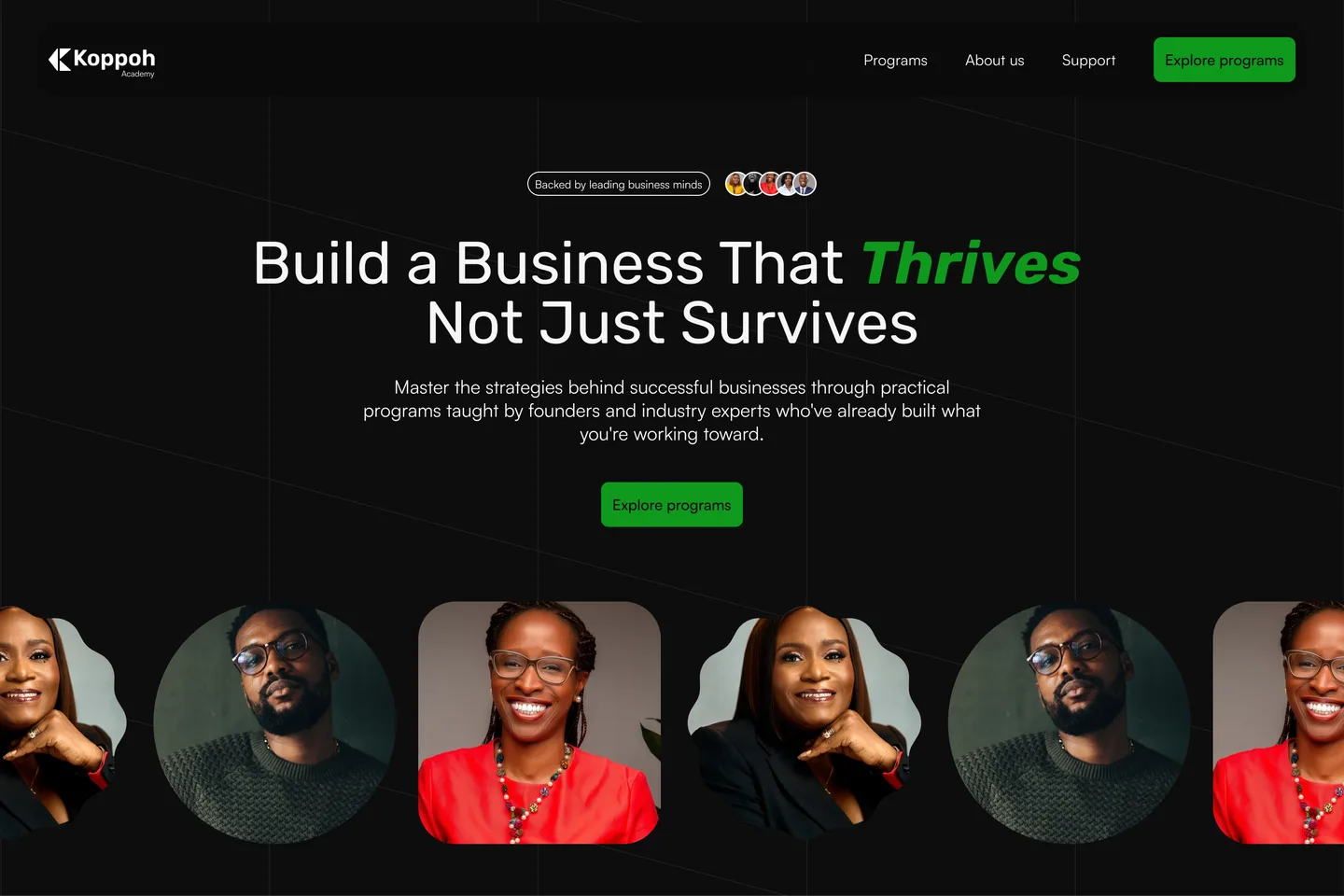
Step 1 of 4The homepage: build a business that thrives, taught by people who have done it
The challenge
Making practical business knowledge accessible
Koppoh Academy had a broader ambition than delivering lessons. It wanted to help entrepreneurs learn from experienced practitioners and apply that knowledge to their own business journeys.
However, turning this ambition into a digital product introduced several interconnected challenges.
Making expert-led education accessible
The platform needed to make valuable industry knowledge available to learners without creating unnecessary barriers to joining a programme. The enrolment experience, payment process, and access to learning all needed to work together.
Reducing friction in enrolment and payment
The original full-payment model worked for some audiences, but it created a barrier for others. Koppoh needed a way to accommodate different purchasing capacities without losing control of enrolment, payment tracking, and access to the platform.
Creating structure without making learning unnecessarily rigid
Koppoh wanted learners to progress through programmes as a cohort, with scheduled classes and lessons rather than unrestricted access to every piece of content from day one. The experience needed to communicate this structure clearly while helping learners understand what they could access, what was coming next, and when they could continue.
Supporting learners throughout the complete journey
The experience extended beyond a course dashboard. Learners needed to discover their programmes, understand their schedules, access lessons, complete quizzes, take a final assessment, and receive their certificates when eligible.
The central design question:
How might we make practical, expert-led business education more accessible while preserving the structure, progression, and accountability needed for a meaningful cohort-based learning experience?
My approach
I was responsible for translating the product requirements and business direction into learner flows, interface designs, and interaction patterns.
I worked closely with the Product Manager to understand the requirements and clarify how the learner experience should behave. I also collaborated with actively with the engineers team for design walkthroughs, handover, implementations and understanding the technologies they might want to adopt for some flows.
Customer Success and marketing team played an important role in surfacing learner needs, particularly around affordability. Their conversations with prospective learners helped the team identify where the existing experience was creating barriers.
My approach was to treat the experience as one connected system rather than a collection of individual screens.
Designing the learner journey from enrolment to certification
The journey:
Selecting a programme and understanding its details.
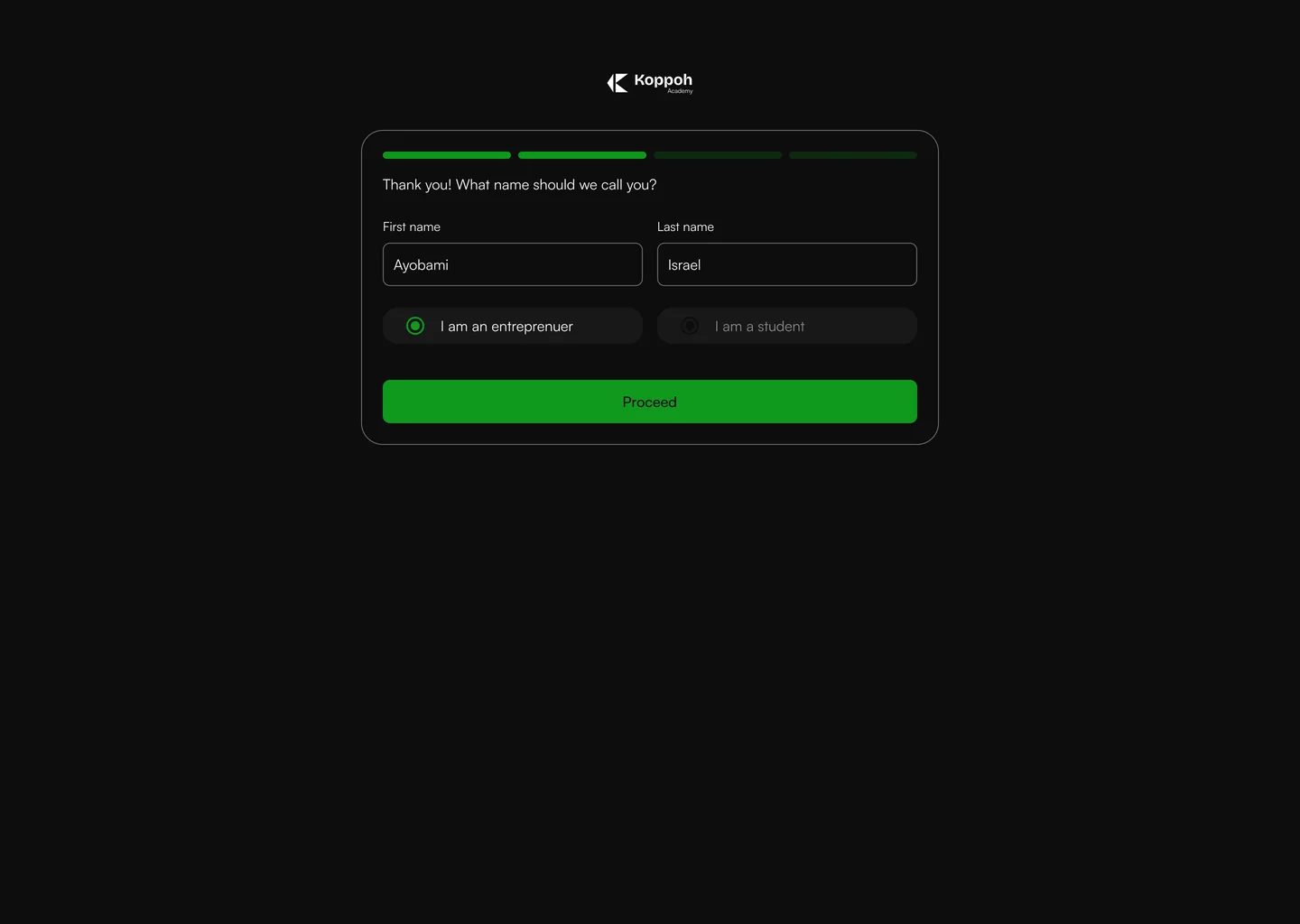
Entering the platform and providing personal information.
Choosing a payment plan and completing the required payment.
Receiving enrolment communications and gaining platform access.
Returning to the dashboard to begin or continue learning.
Working through scheduled modules, lessons, and quizzes.
Completing the final assessment within its designated window.
Accessing a certificate after meeting the programme's completion requirements.
Removing financial friction from the enrolment
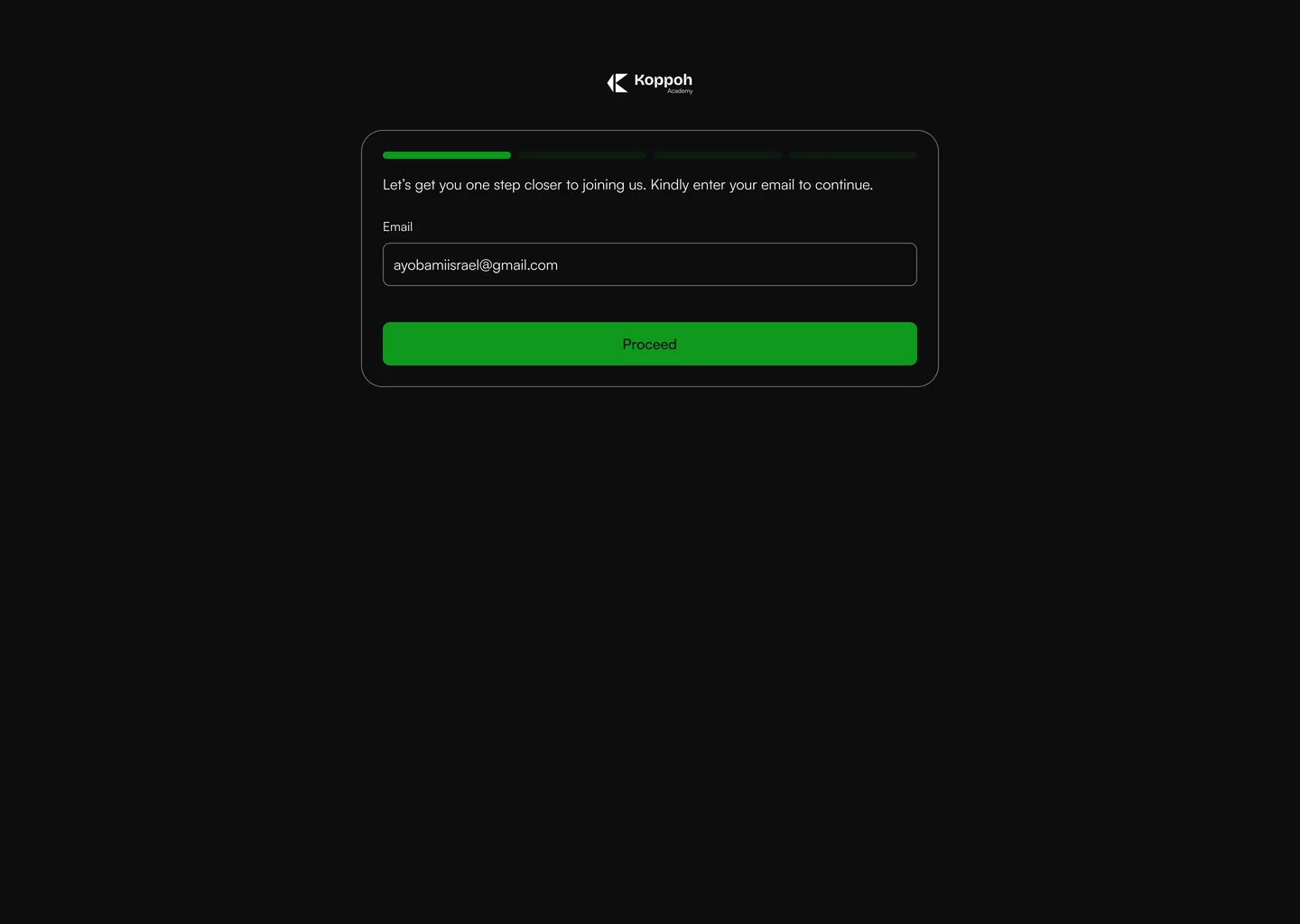
Step 1 of 9Starting with an email address
The problem with a full-payment-only model
Initially, learners could pay for a programme only in full.
This model worked for the first event-planning programme, whose audience included established business owners with the capacity to pay the full fee. However, the audience for the subsequent photography programme was younger and included more Gen Z learners, many of whom had less purchasing power.
Customer Success spoke directly with prospective learners and identified affordability as a significant barrier to enrolment. The Product Manager shared this insight with me, and it informed the decision to introduce instalment payments.
The business challenge was to make programmes more accessible without creating confusion around payment obligations, compromising payment tracking, or granting platform access before the required payments were completed.
Designing flexible payment options
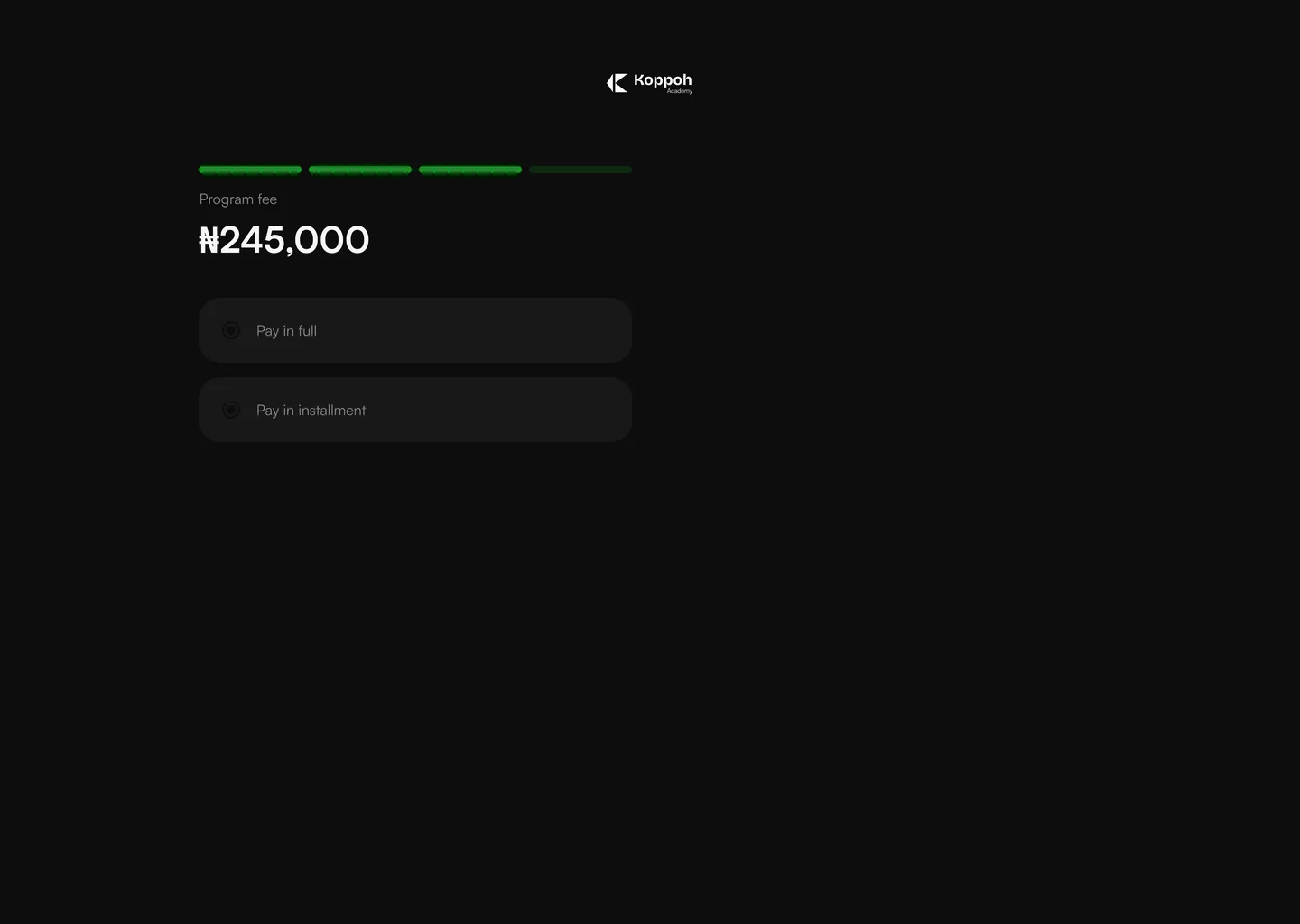
The updated payment experience offered three choices:
Full payment.
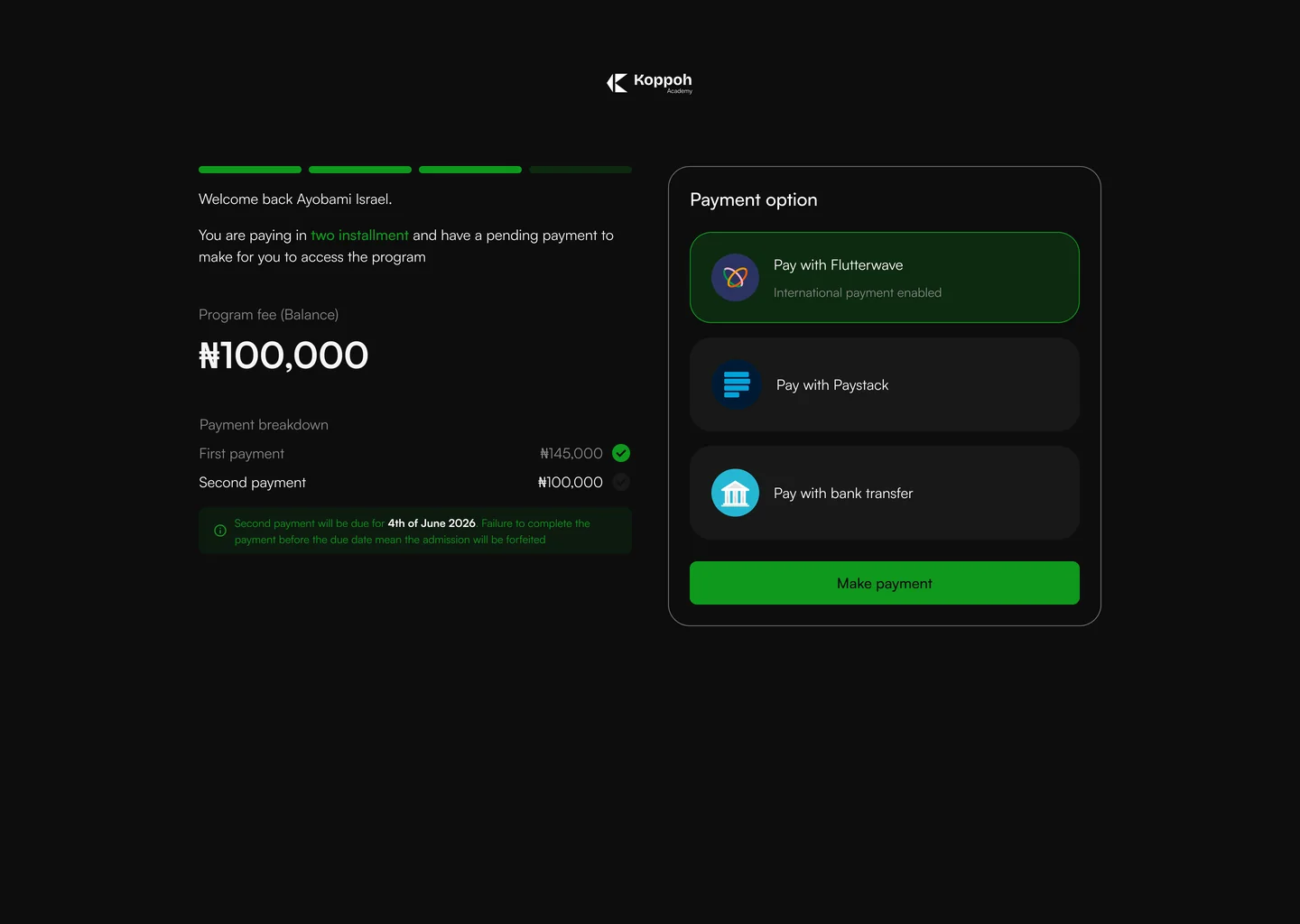
Payment in two instalments.
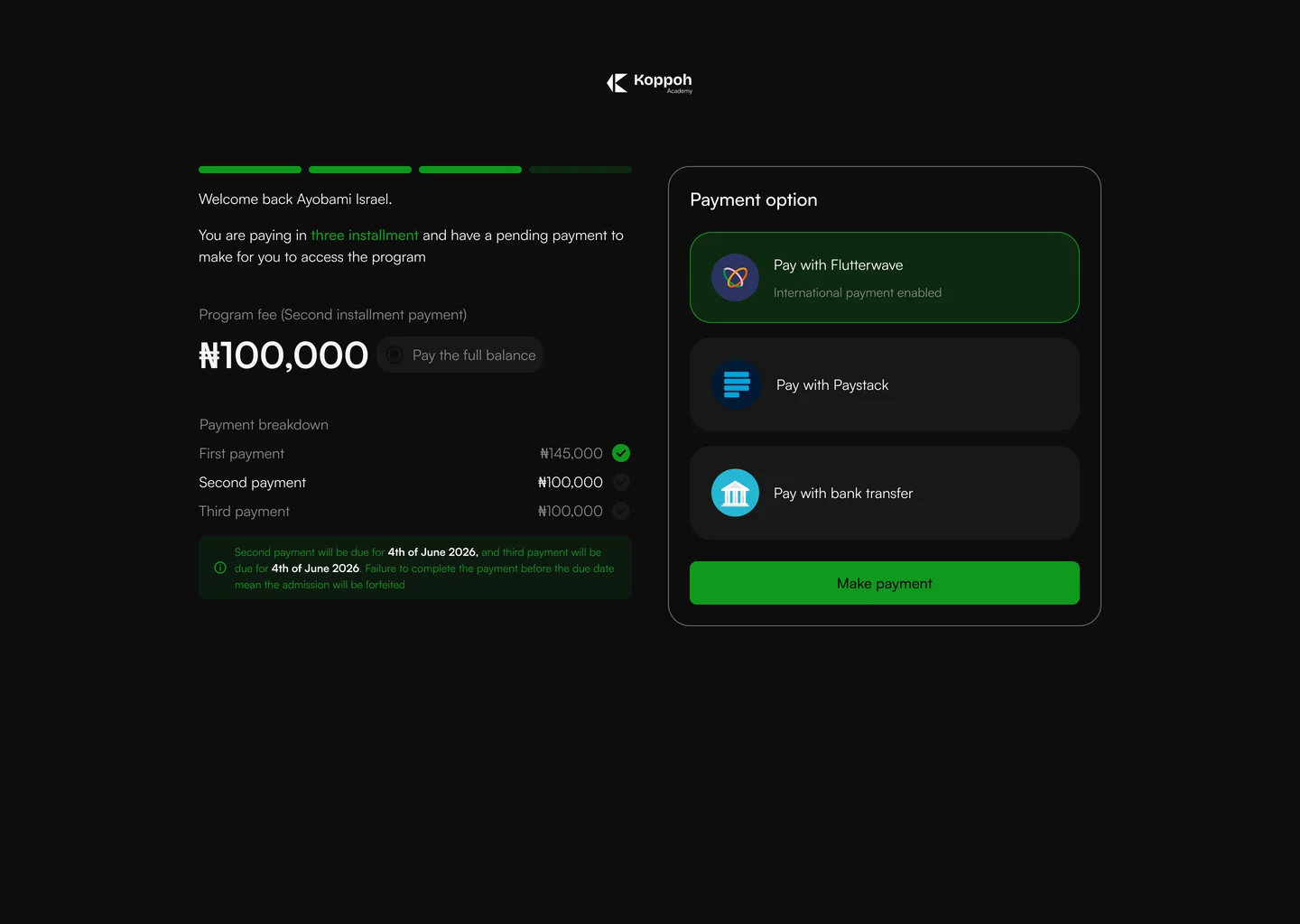
Payment in three instalments.
Rather than presenting these as simple labels, the interface needed to explain the financial commitment associated with each option.
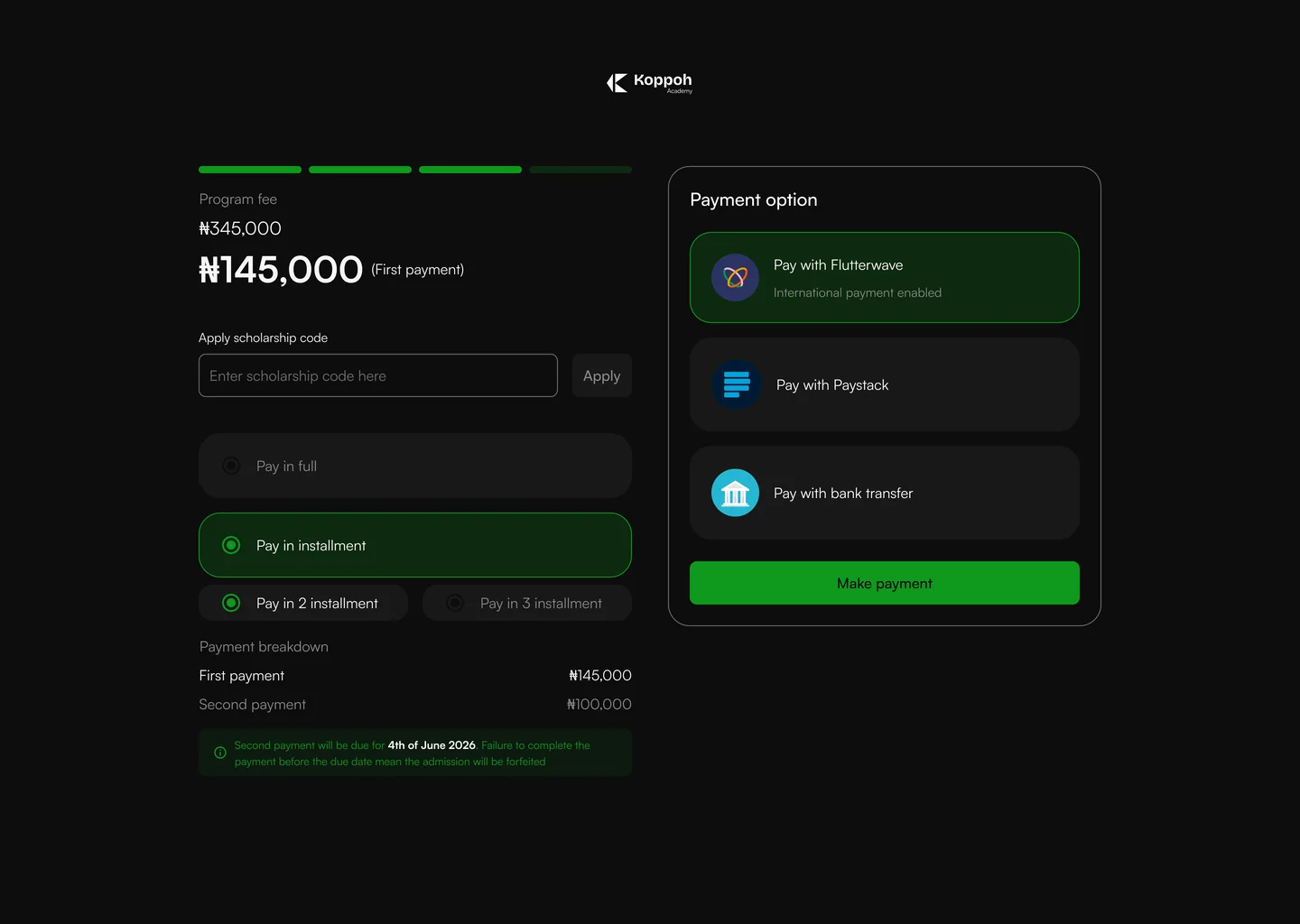
When learners selected a plan, the payment information updated to show the amount due immediately, the remaining amounts, and their respective due dates. This helped learners understand both the initial cost and the commitment they were taking on.
The goal was to support an informed decision, not simply make the first payment appear smaller.
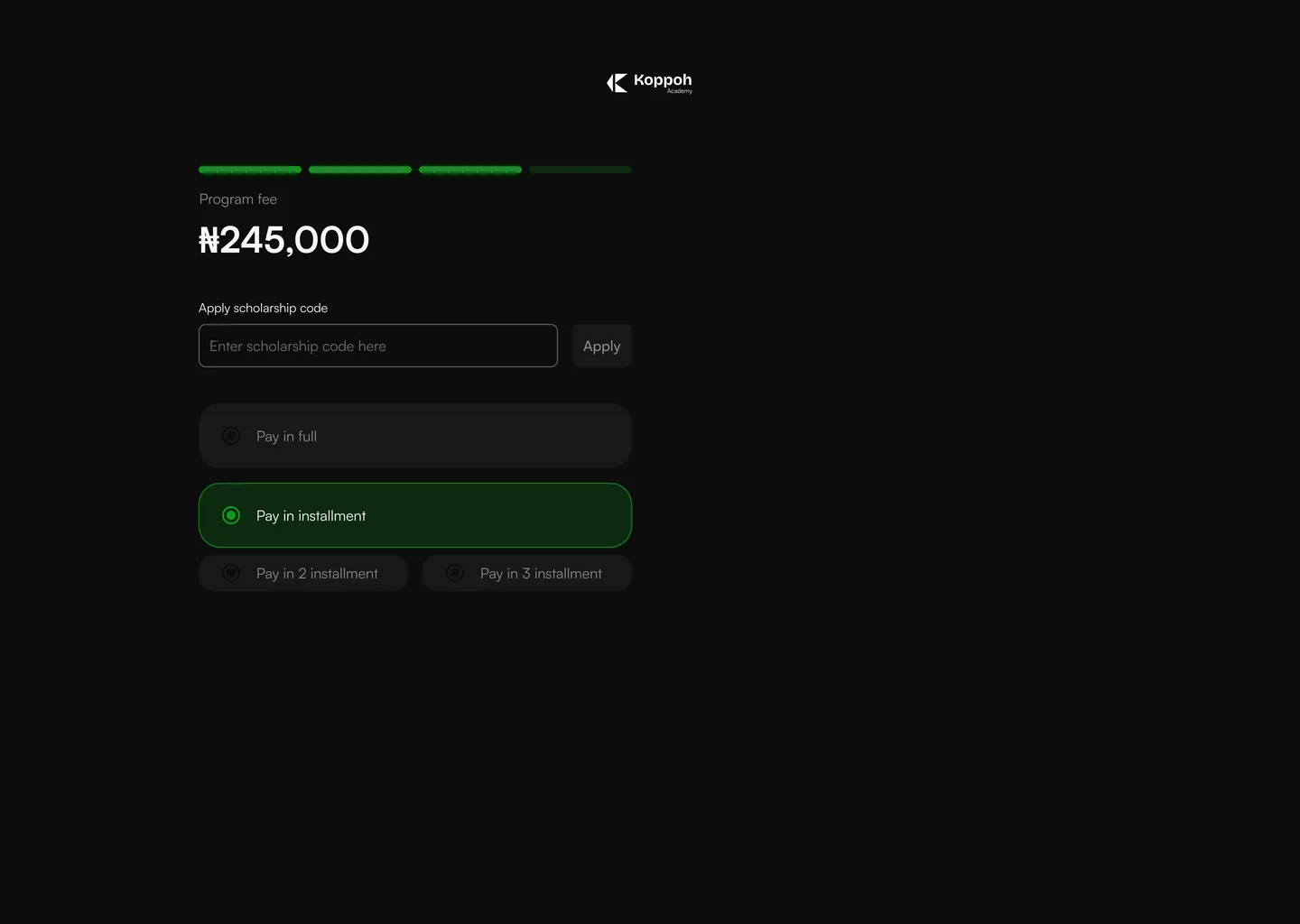
Making scholarship discounts understandable
The payment flow also supported scholarship codes.
After selecting a payment option, learners could enter an eligible code to receive a discount. Because the discount affected the overall programme fee, the interface needed to communicate how it changed the total and the amounts due under the selected payment plan.
The updated breakdown made the discount and revised payment amounts visible, helping learners distinguish between what they needed to pay immediately and what remained outstanding.
This was especially important for instalment plans, where a learner needed to understand the relationship between the discounted total and each scheduled payment.
Connecting payment to onboarding
Payment was not an isolated transaction. It determined when a learner could enter the platform.
Under the earlier process, bank transfers required manual verification. Learners could then be contacted to provide information and have their accounts created. This introduced additional coordination between payment confirmation and onboarding.
With the updated flow, payment verification and email communications supported a more self-service enrolment process.
For learners paying in instalments, the experience also needed to support the full payment lifecycle:
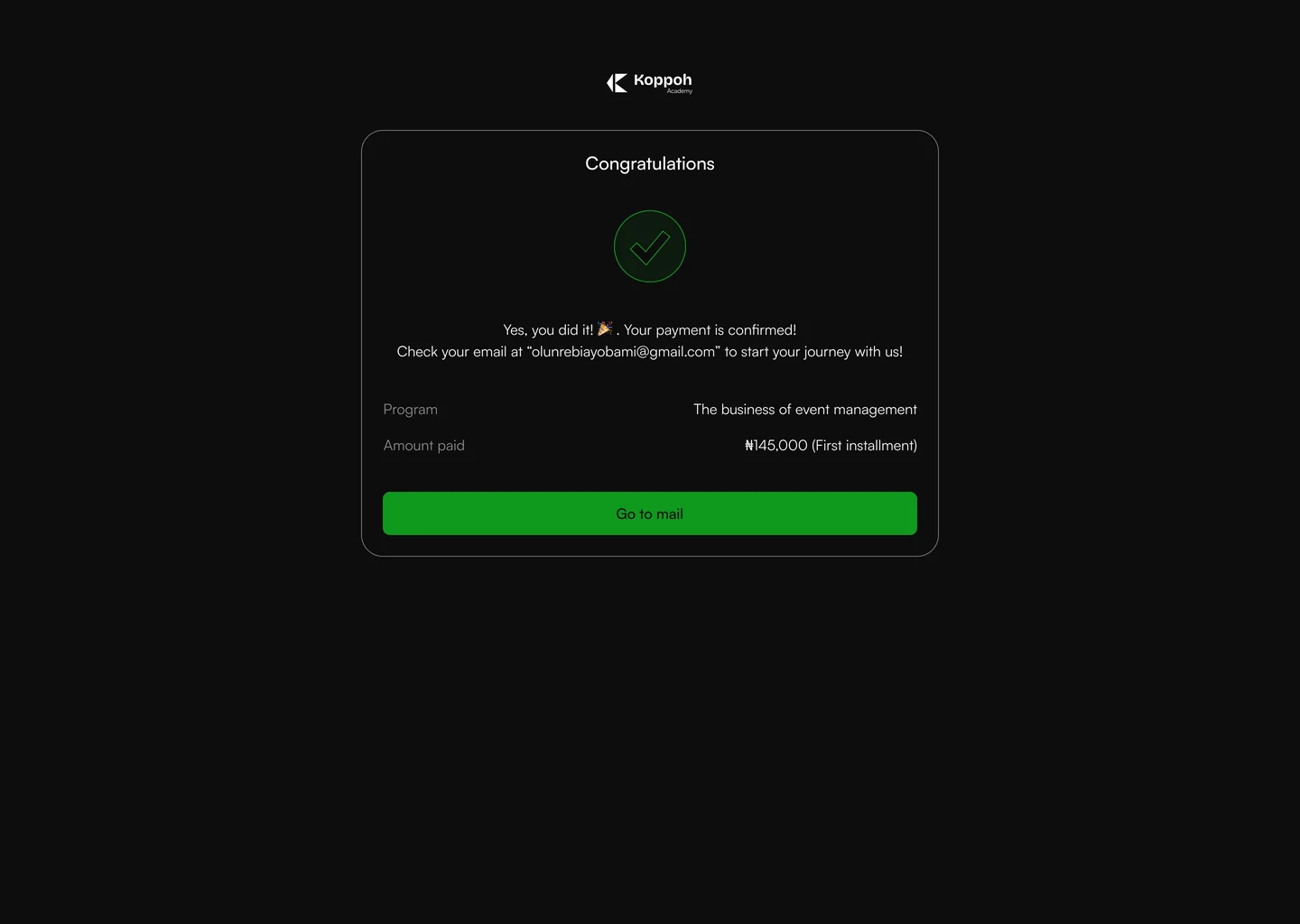
After the initial payment, learners received confirmation.
Follow-up communications showed the next amount due and its payment date.
Reminder emails helped learners keep track of upcoming payments.
Returning through a payment link allowed learners to see their previous payment and outstanding balance before continuing.
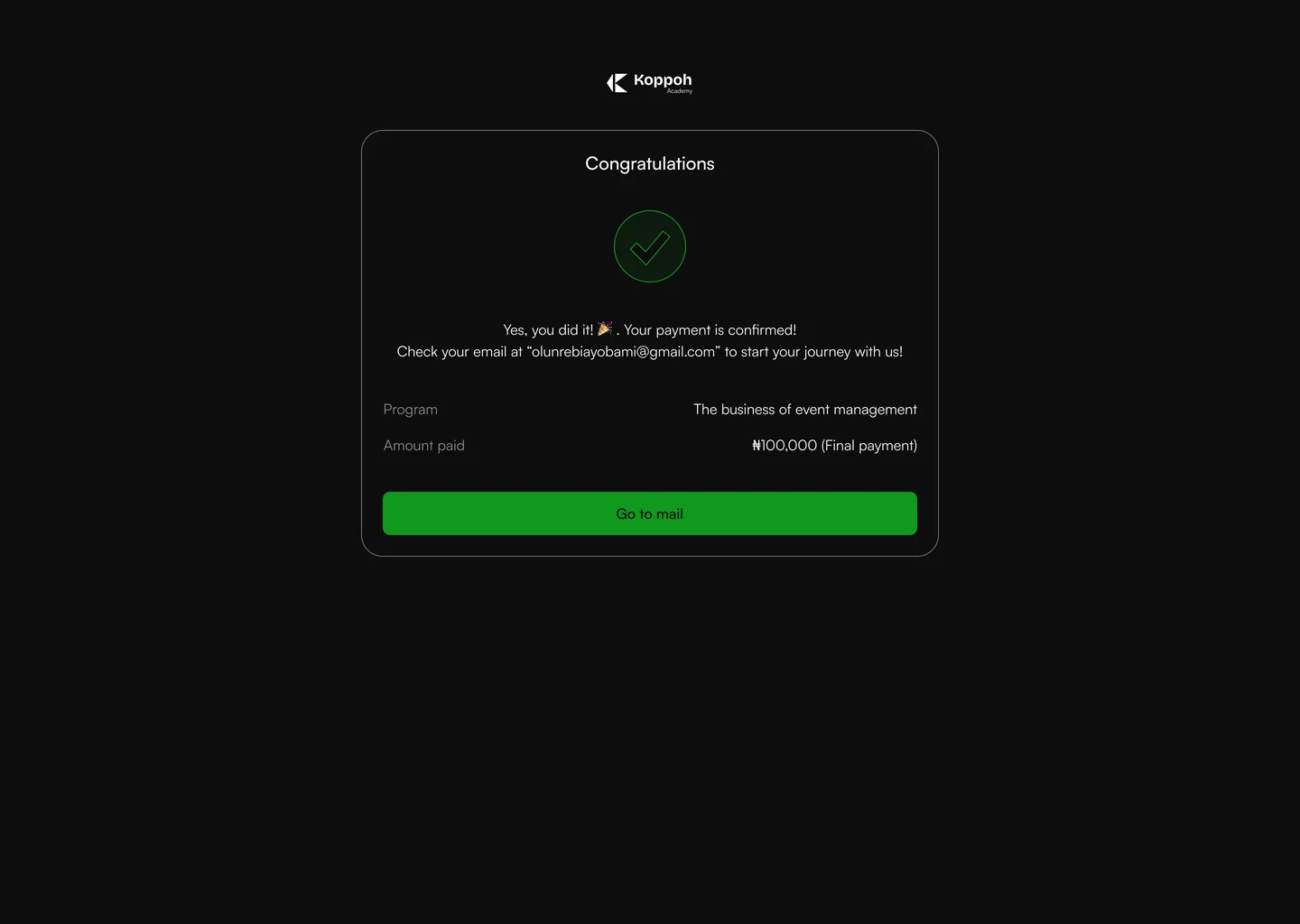
Platform access was provided after all required instalments had been completed.
This approach helped separate the decision to enrol from the operational steps needed to confirm full payment and activate access.
The design principle: Financial flexibility only works when learners can clearly understand their obligations and the system consistently communicates what happens next.
What changed
The introduction of instalments gave prospective learners another way to pay. Following the change, the team observed better learner uptake and re-engaged prospects who had previously faced affordability barriers.
Marketing and Customer Success team follow-ups and automated emails also supported payment completion.
However, we did not establish a quantified before-and-after conversion rate or a verified reduction in manual support effort. I therefore treat these as observed outcomes rather than a measured conversion uplift attributable to the interface alone.
Designing for cohort-based learning
Koppoh Academy was not intended to function like a library where every learner could immediately access every lesson at any time.
Its programmes followed a cohort model, with defined start and end dates, scheduled live classes, and a shared learning timeline. The business wanted learners to move through the programme together rather than consume content in an entirely self-directed way.
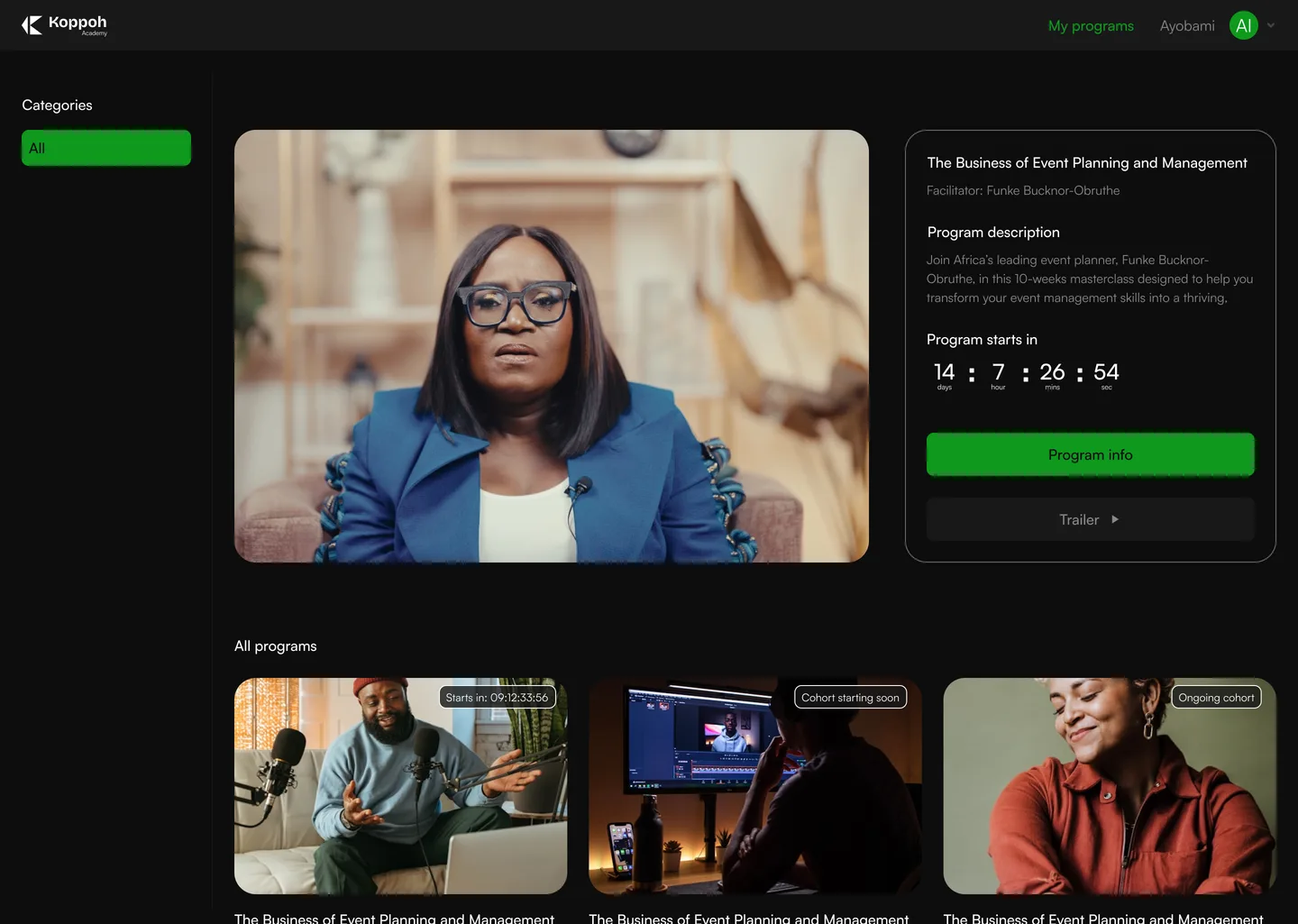
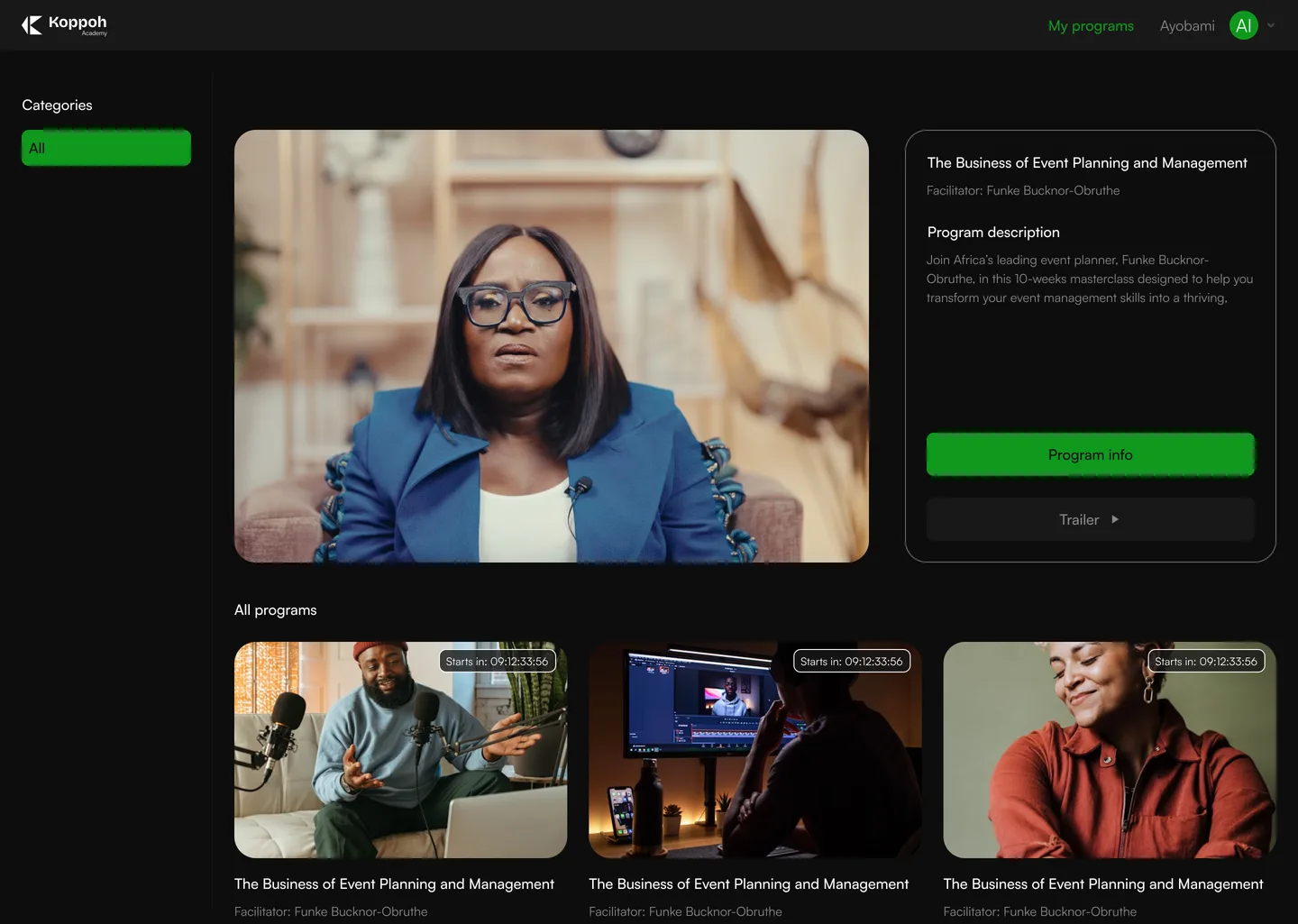
Step 1 of 7A newly enrolled learner's dashboard: a countdown to the cohort's start, with the trailer and programme info
Making programme status clear on the dashboard
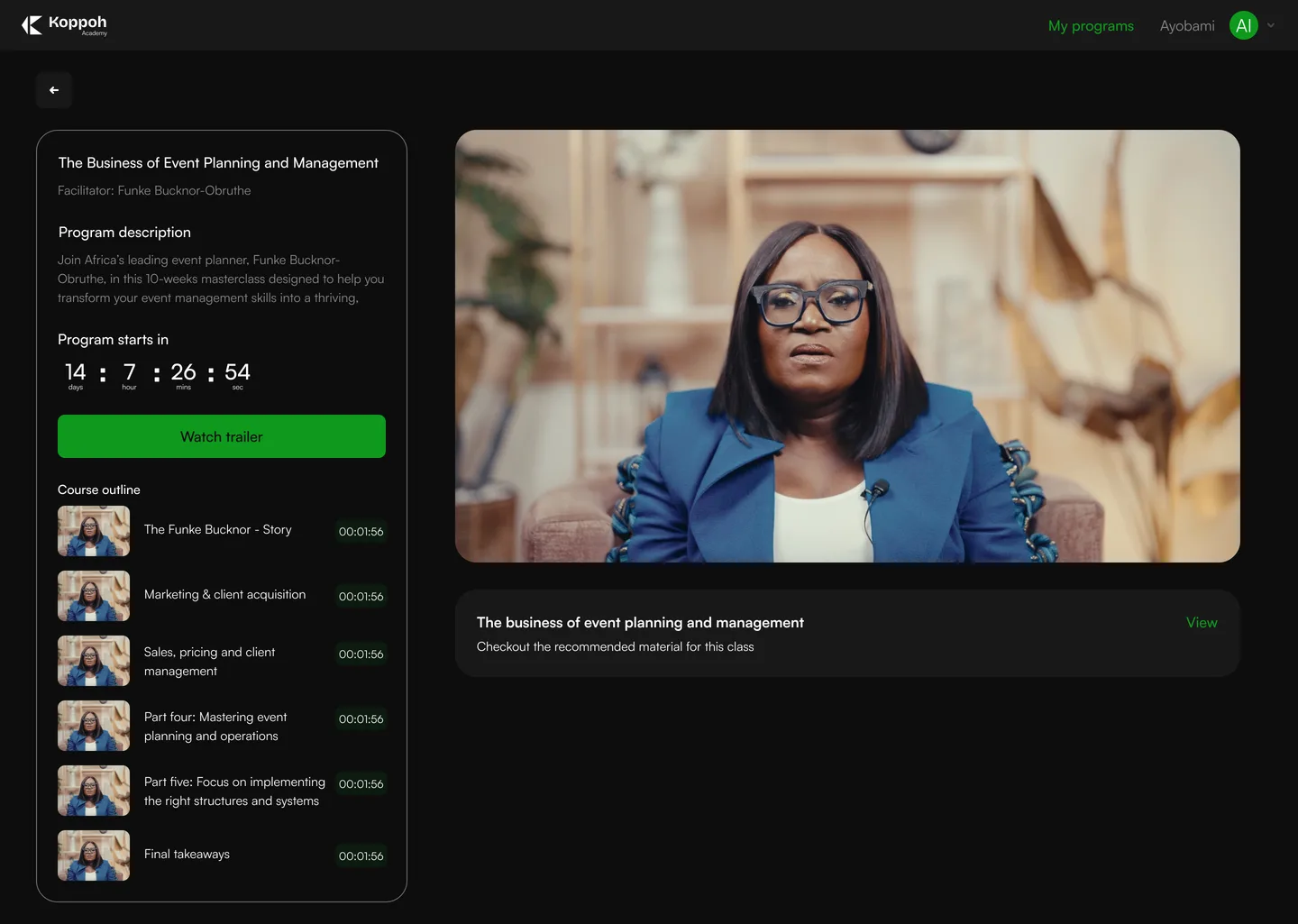
For a newly enrolled learner whose cohort had not started, the dashboard displayed a prominent banner for the registered programme. The banner included a countdown to the start date, alongside options to watch the programme trailer or view more information.
Lessons remained locked until the scheduled start.
Once the programme began, the countdown disappeared and the learner could begin the learning experience.
This distinction helped the dashboard serve two purposes: reassuring learners that their enrolment was active before the cohort started, and directing them towards learning when the programme became available.
For returning learners, the experience prioritised continuity. They landed on the My Courses area, making it easier to locate an ongoing programme and resume learning without having to navigate the initial enrolment experience again.
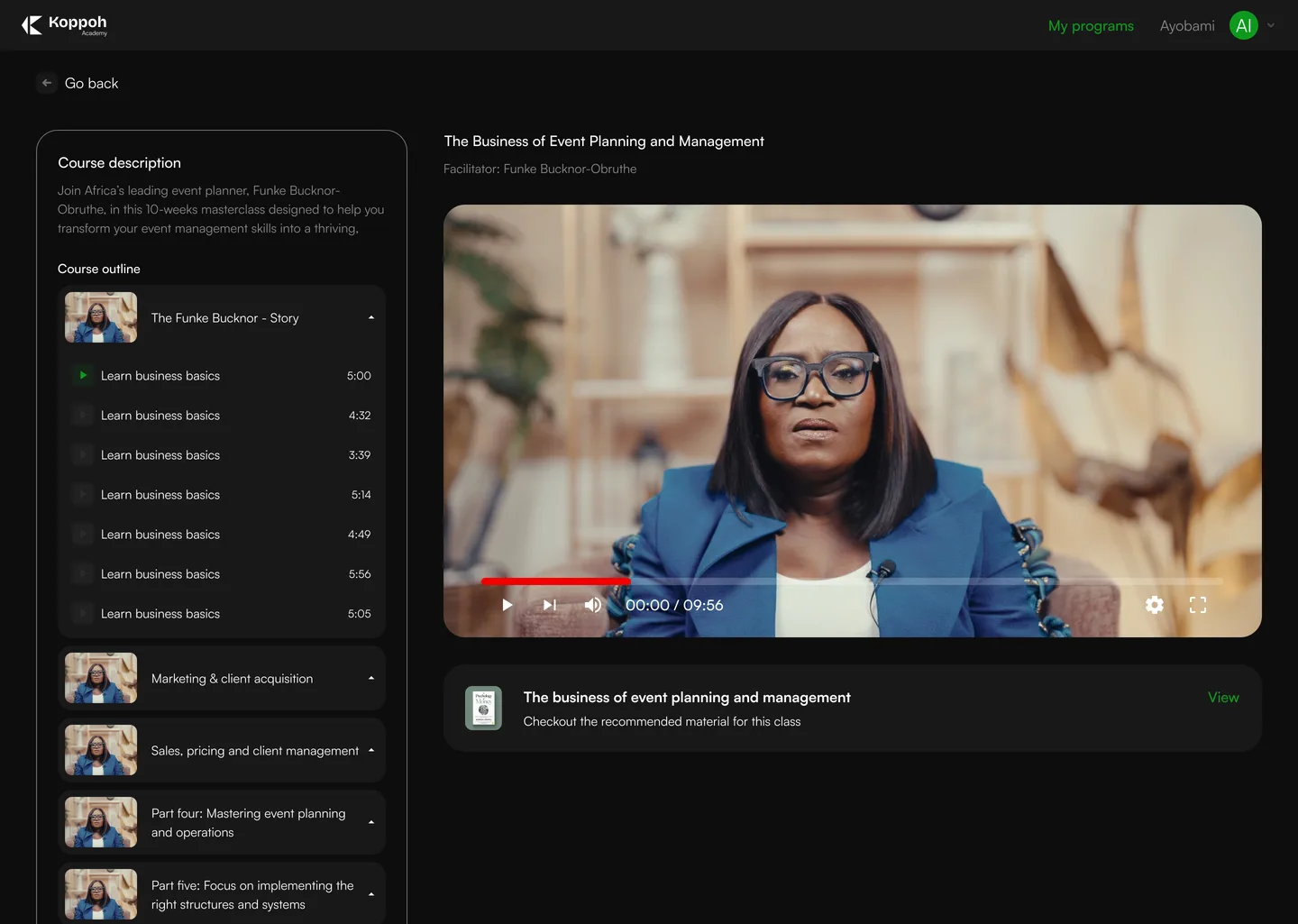
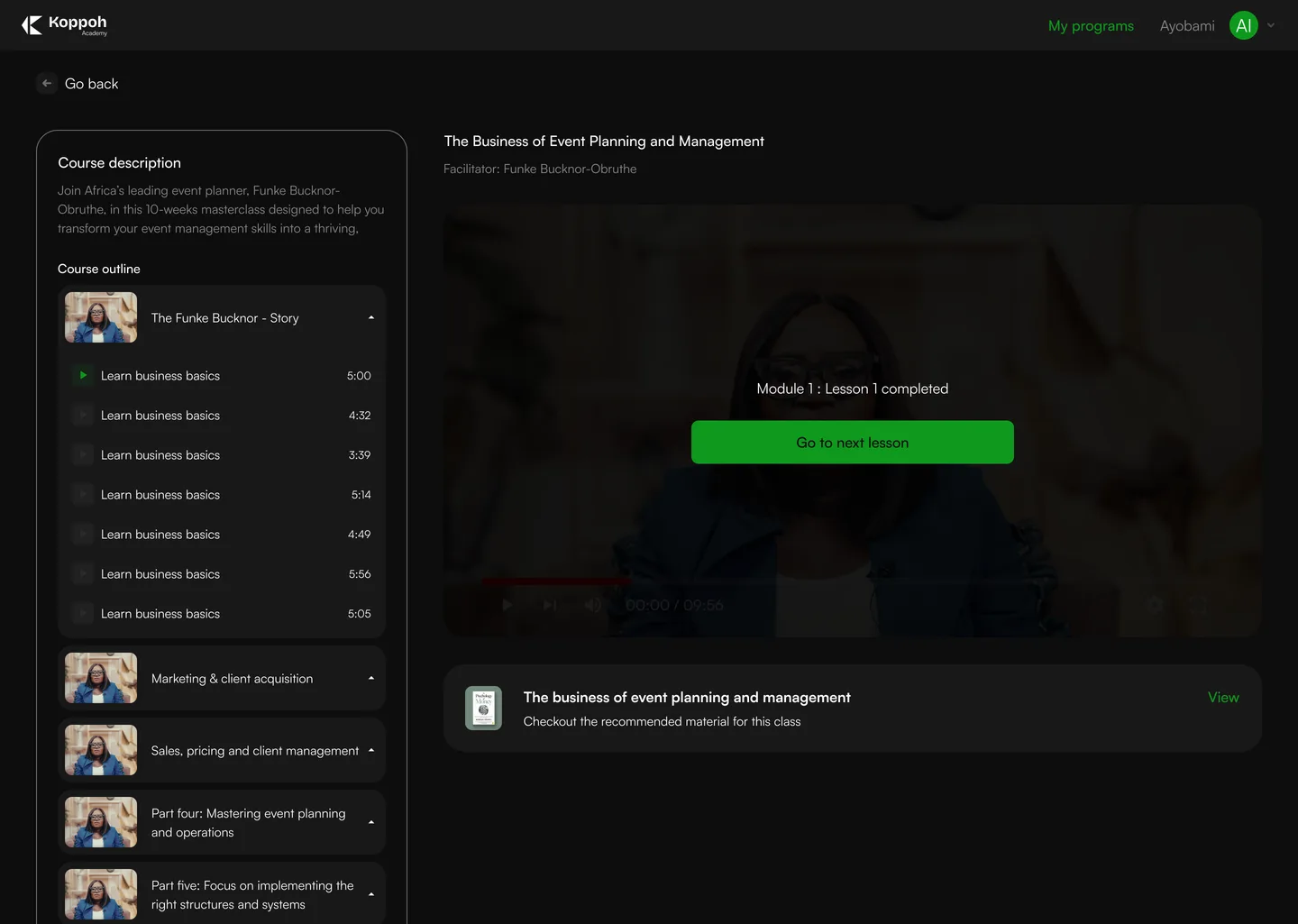
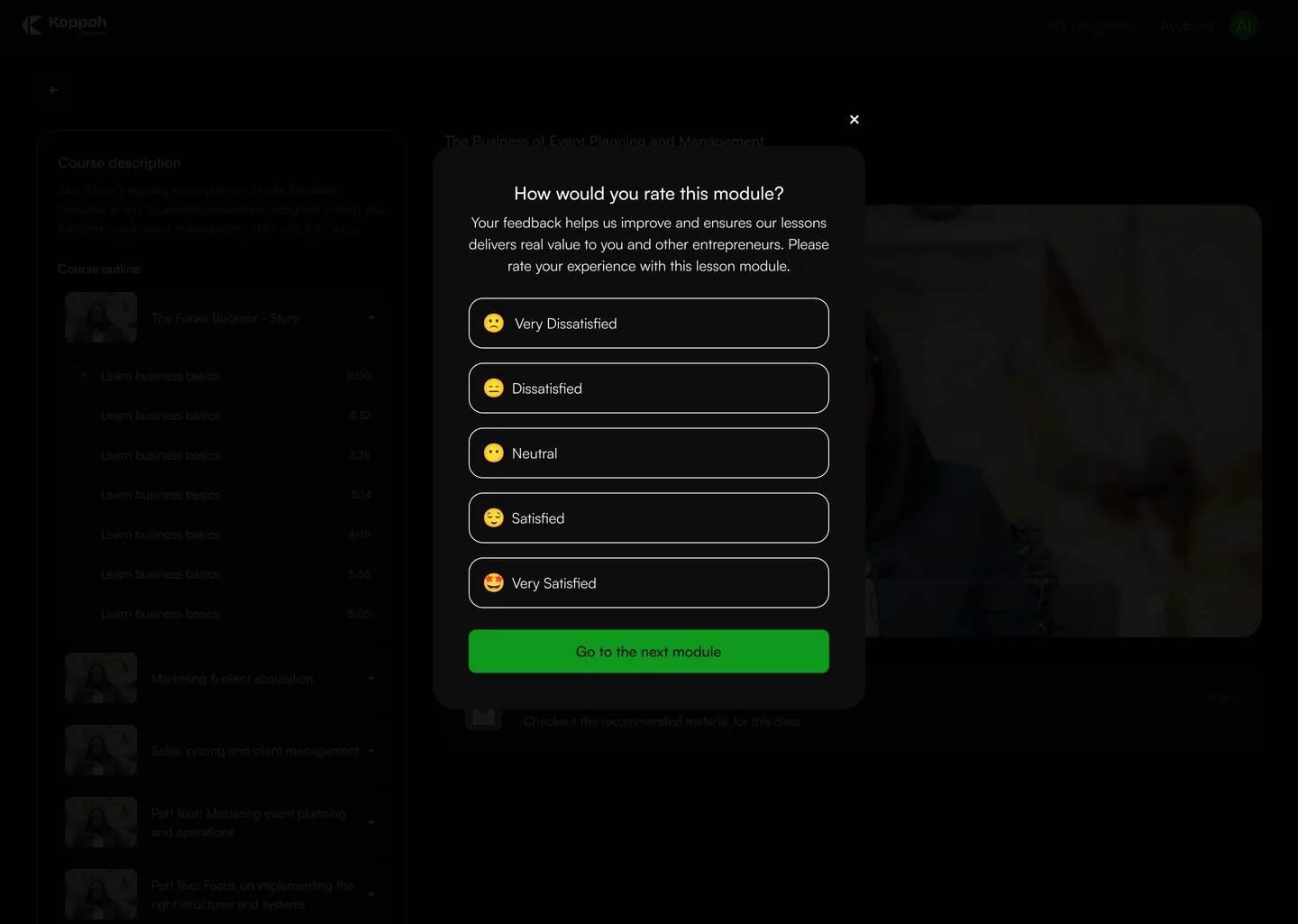
Organising the classroom around modules and lessons
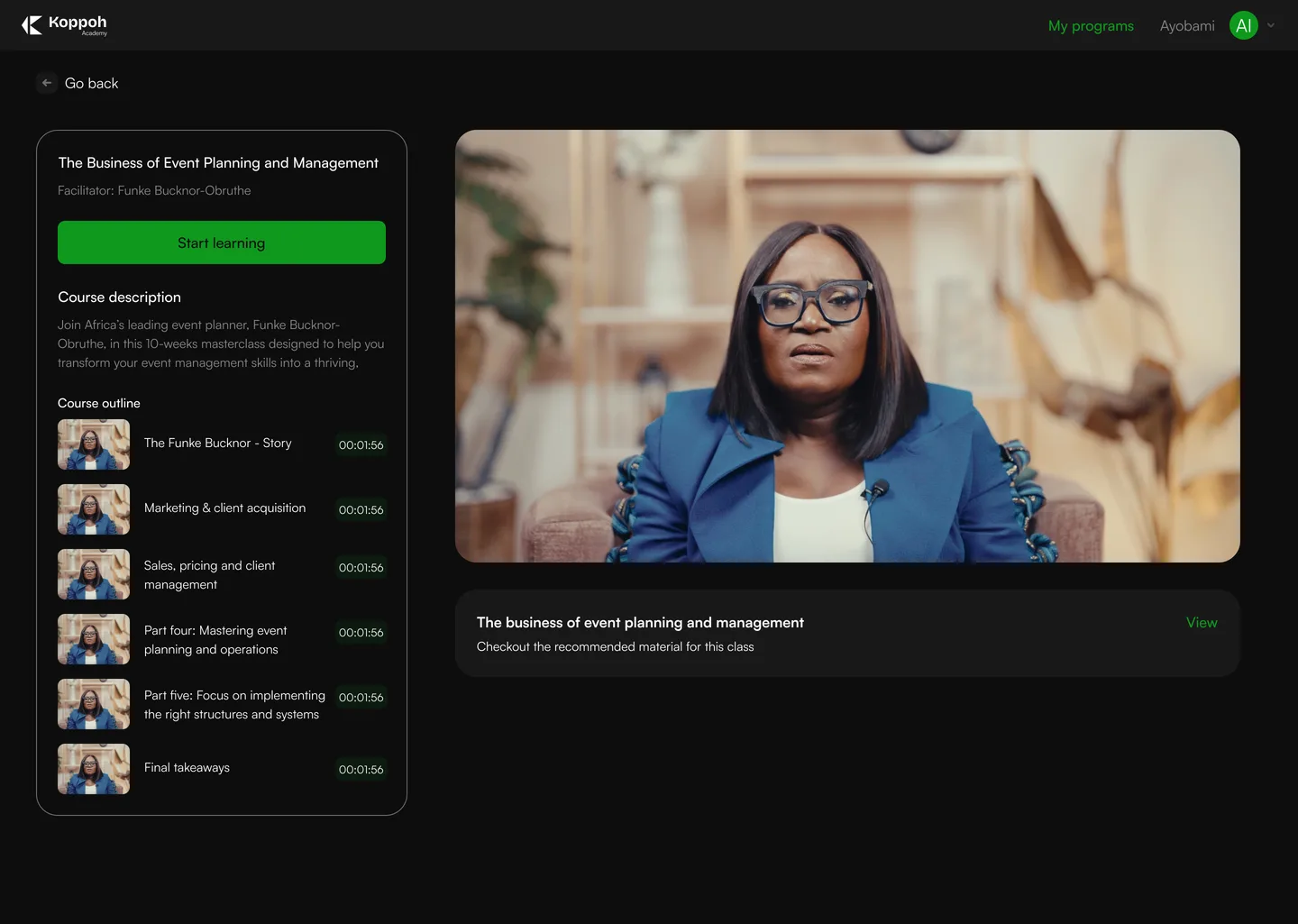
Within a programme, content was organised into modules, with lessons and quizzes forming the learning structure.
I designed the experience to make this hierarchy clear so learners could understand how individual lessons fitted into the broader programme.
The interface also needed to communicate availability. A lesson could be part of the programme but still be unavailable because its scheduled release date had not arrived.
Lock indicators helped distinguish content that was available from content that was scheduled for later. This reduced ambiguity and made the cohort structure visible within the classroom itself.
The experience was therefore not only a way to access content. It also communicated the rules and rhythm of the programme.
Balancing learner progress with scheduled content release
In a fully self-paced product, a learner might complete several lessons in one sitting. Koppoh's cohort model required lessons to become available according to a schedule, even when a learner was ready to move ahead.
For example, a learner might finish the current week's lessons early, but the next set of lessons would remain locked until its scheduled release later in the week.
The interface needed to make this behaviour understandable rather than make it feel like a technical error or a broken link.
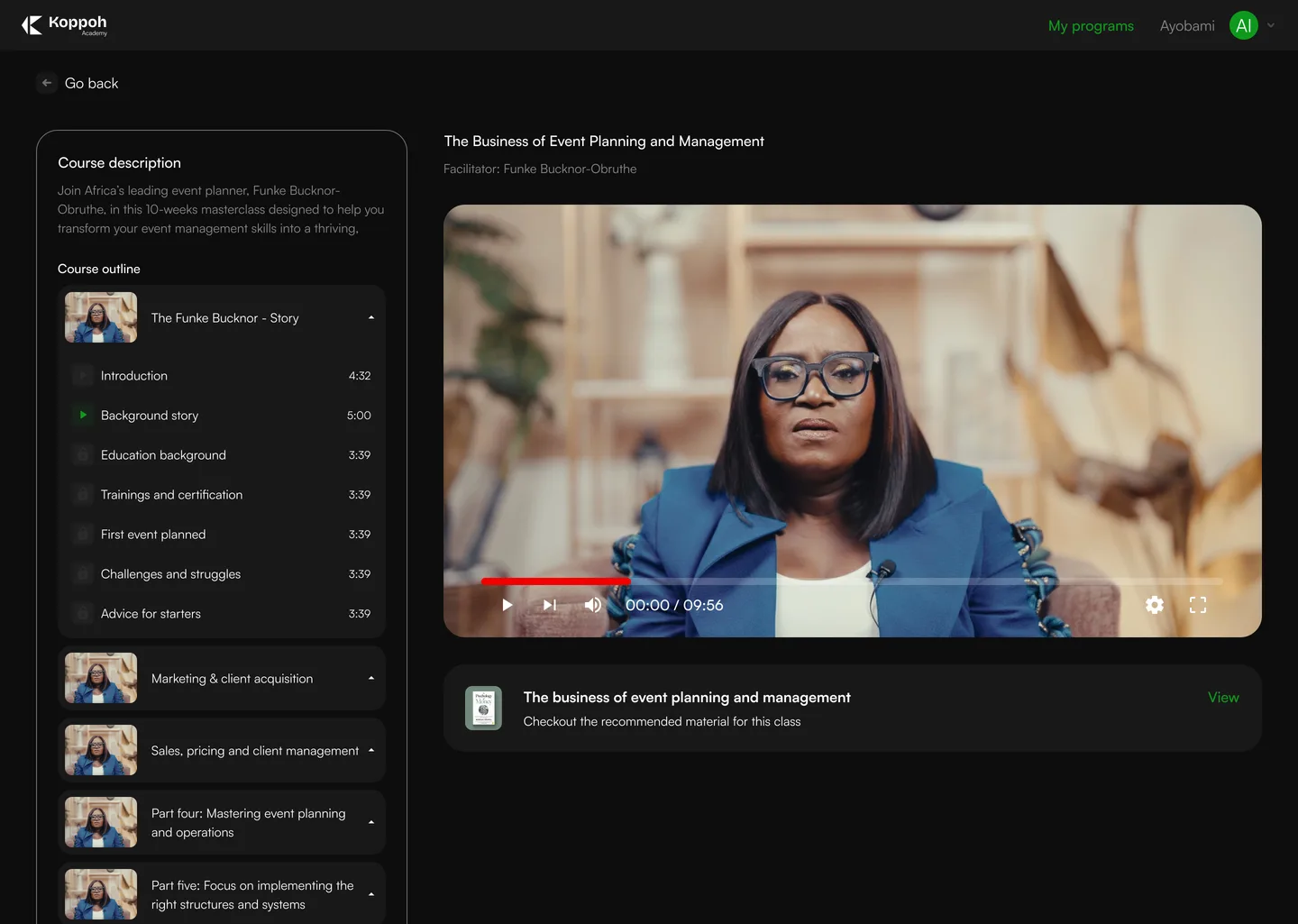
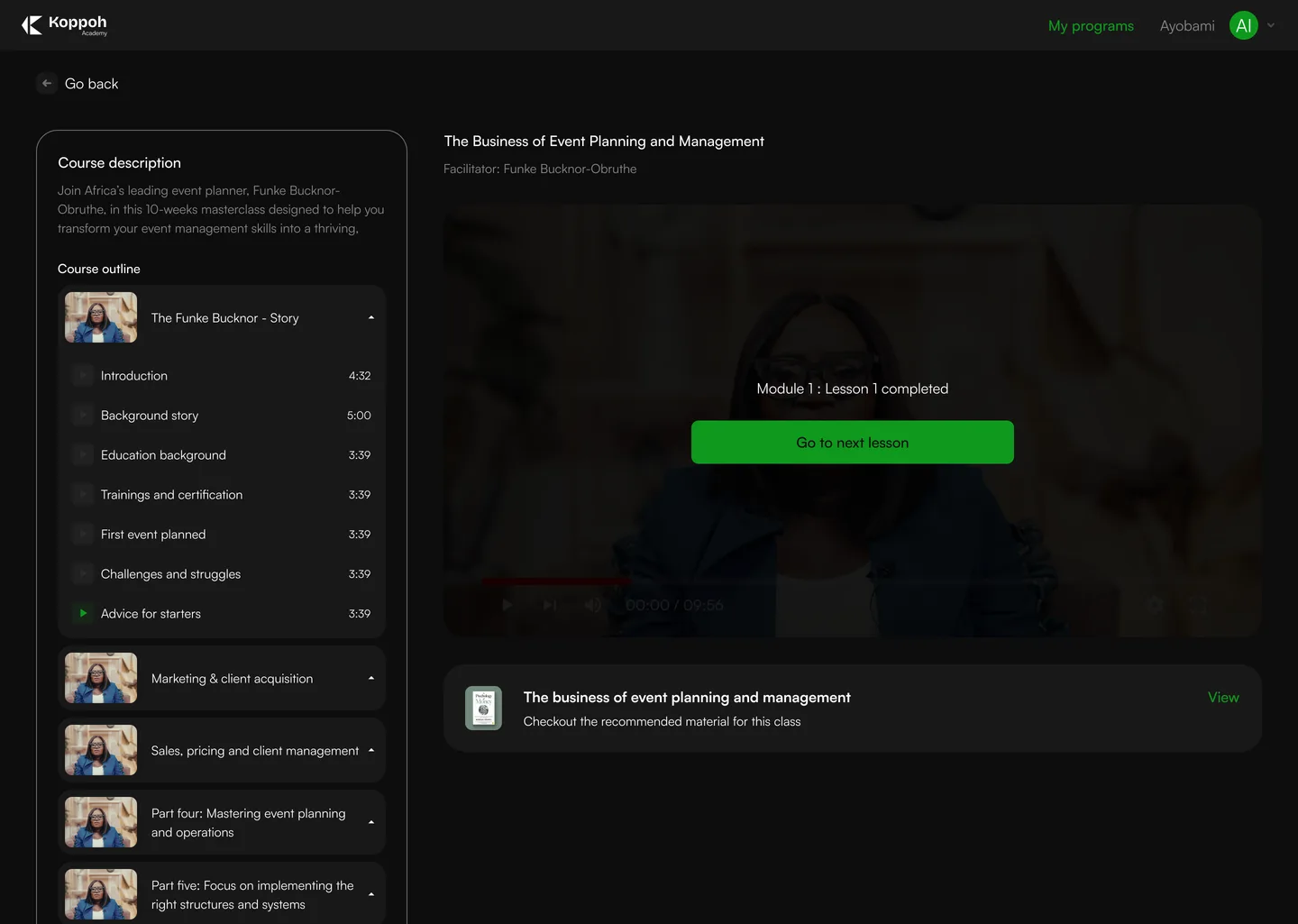
Step 1 of 2The module's lessons in the outline, with the learner's place marked
Communicating what learners could and could not access
I used clear lesson availability states and lock indicators to show which lessons were currently accessible and which were not.
This helped communicate that unavailable content was part of the programme schedule, not something the learner had missed or lost access to.
The experience also reflected a distinction between content availability and learner completion.
New modules were released according to the programme schedule, even if a learner had not completed every lesson in the previous module. This avoided turning the platform into a punitive system where falling behind once could prevent a learner from accessing all subsequent content.
Why this mattered
The challenge was not simply to lock and unlock lessons. It was to preserve the structure of a shared learning experience while keeping learners informed and able to continue.
The resulting approach respected the programme's scheduled rhythm without unnecessarily blocking access to later modules because of incomplete earlier work.
Designing the quizzes, final assessments, and certification
The learning experience needed to support more than lesson consumption. It also needed a clear path from learning to assessment and programme completion.
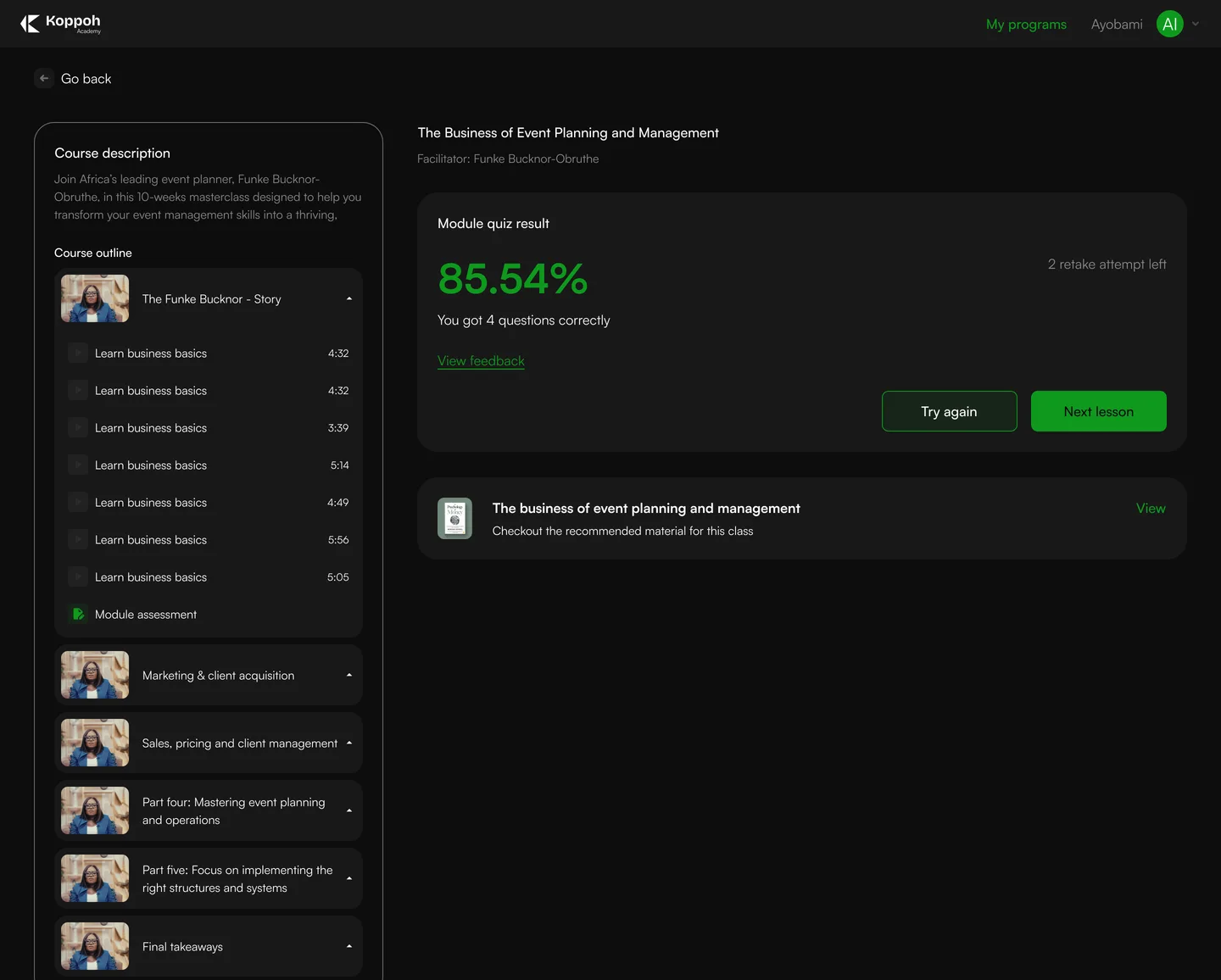
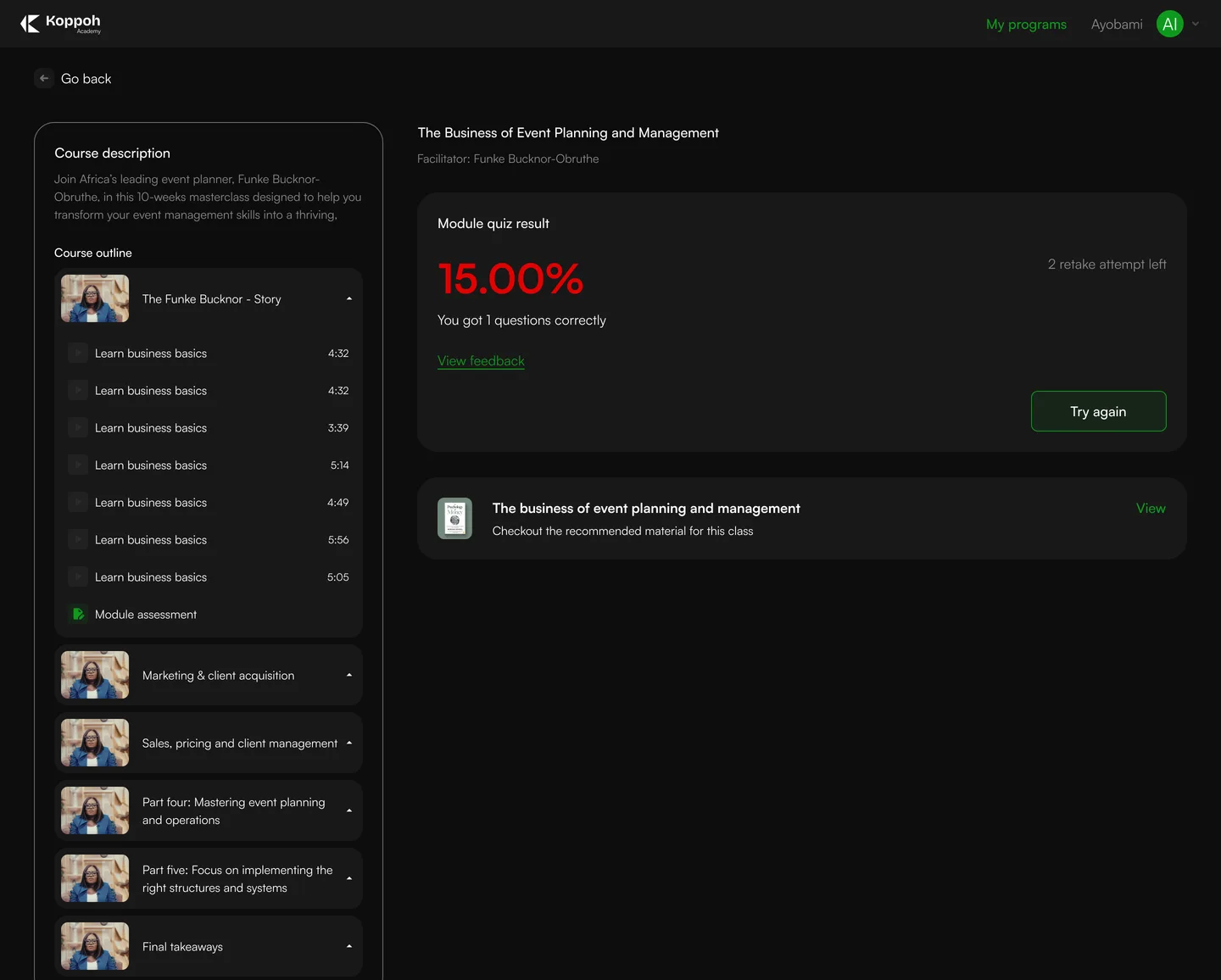
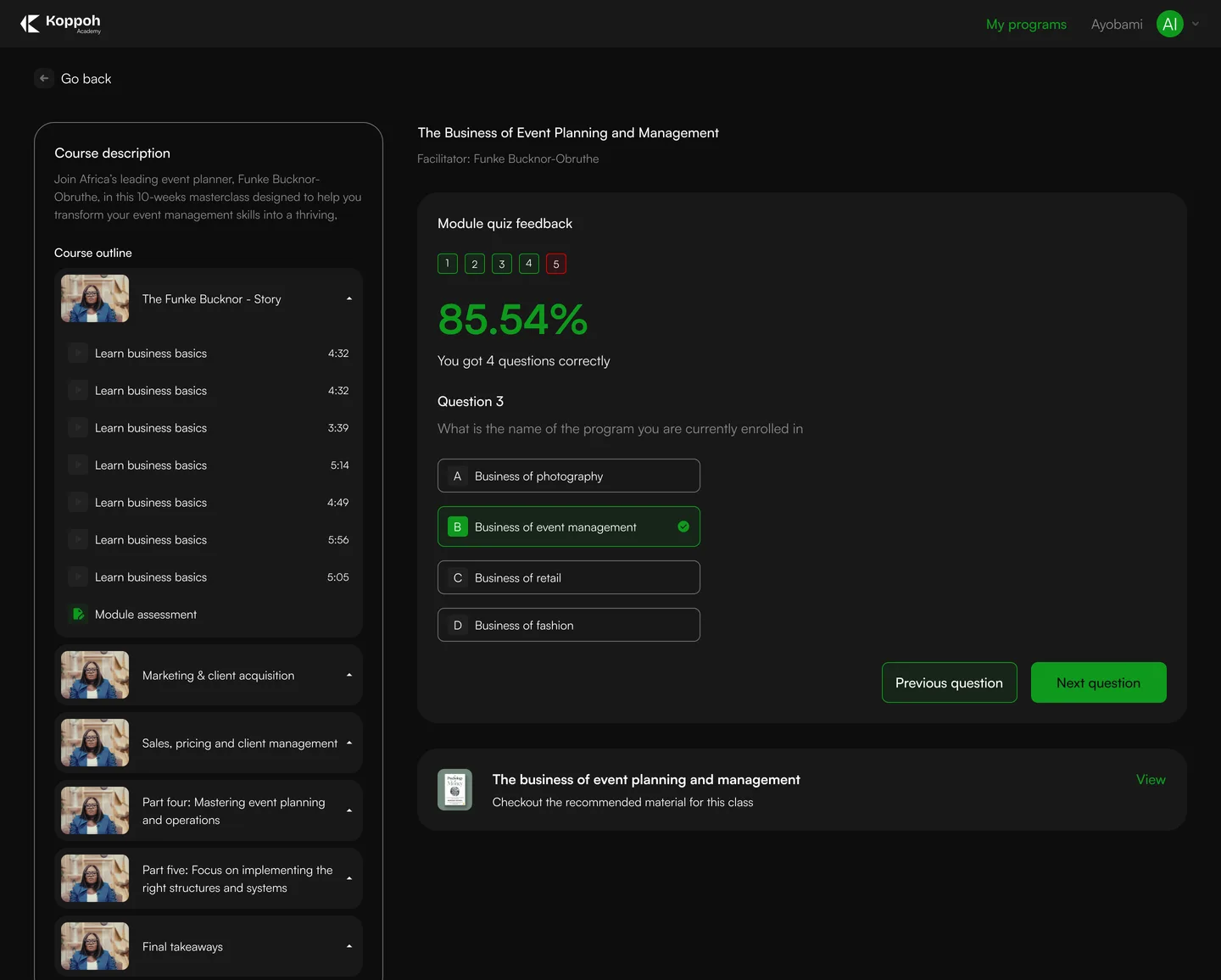
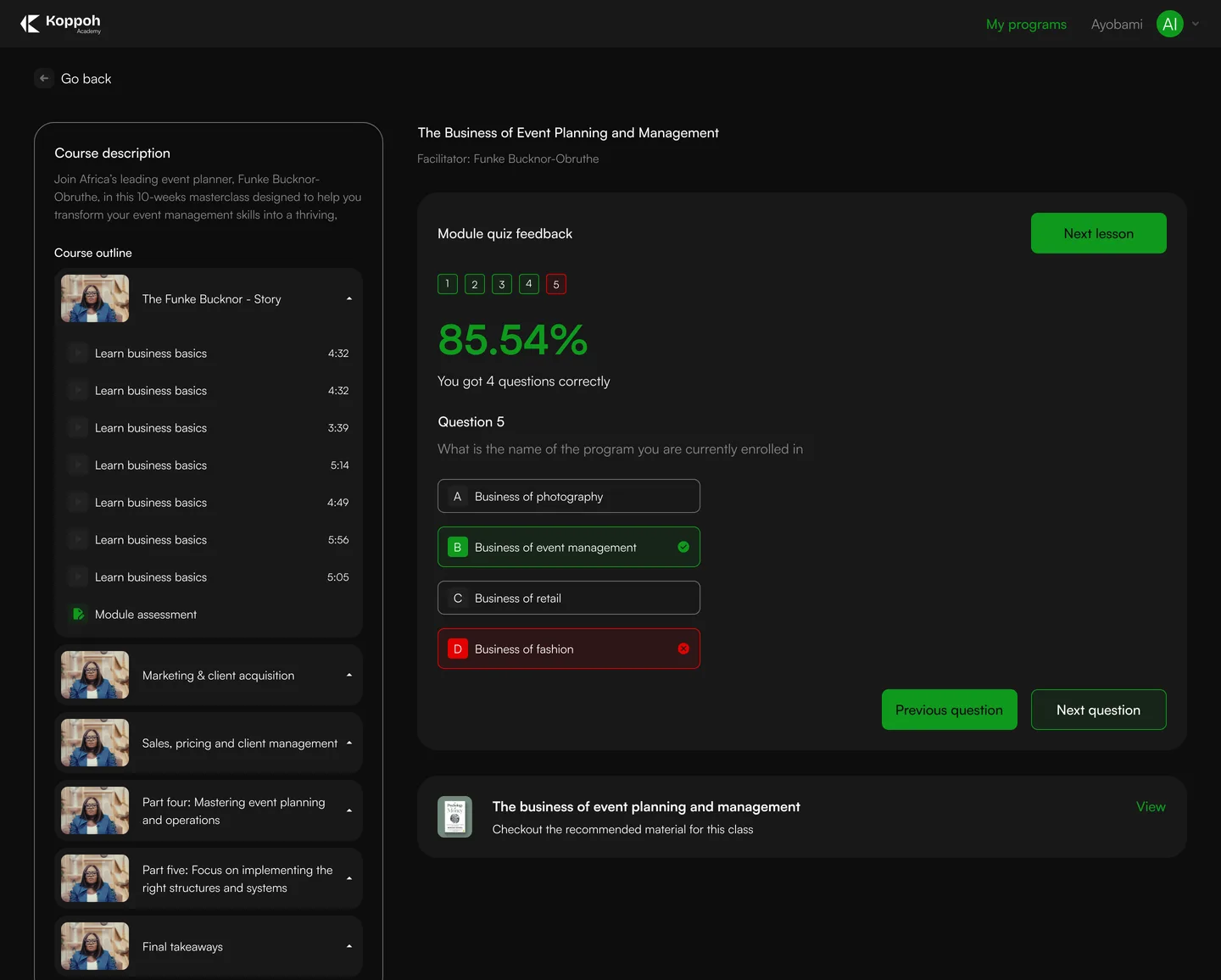
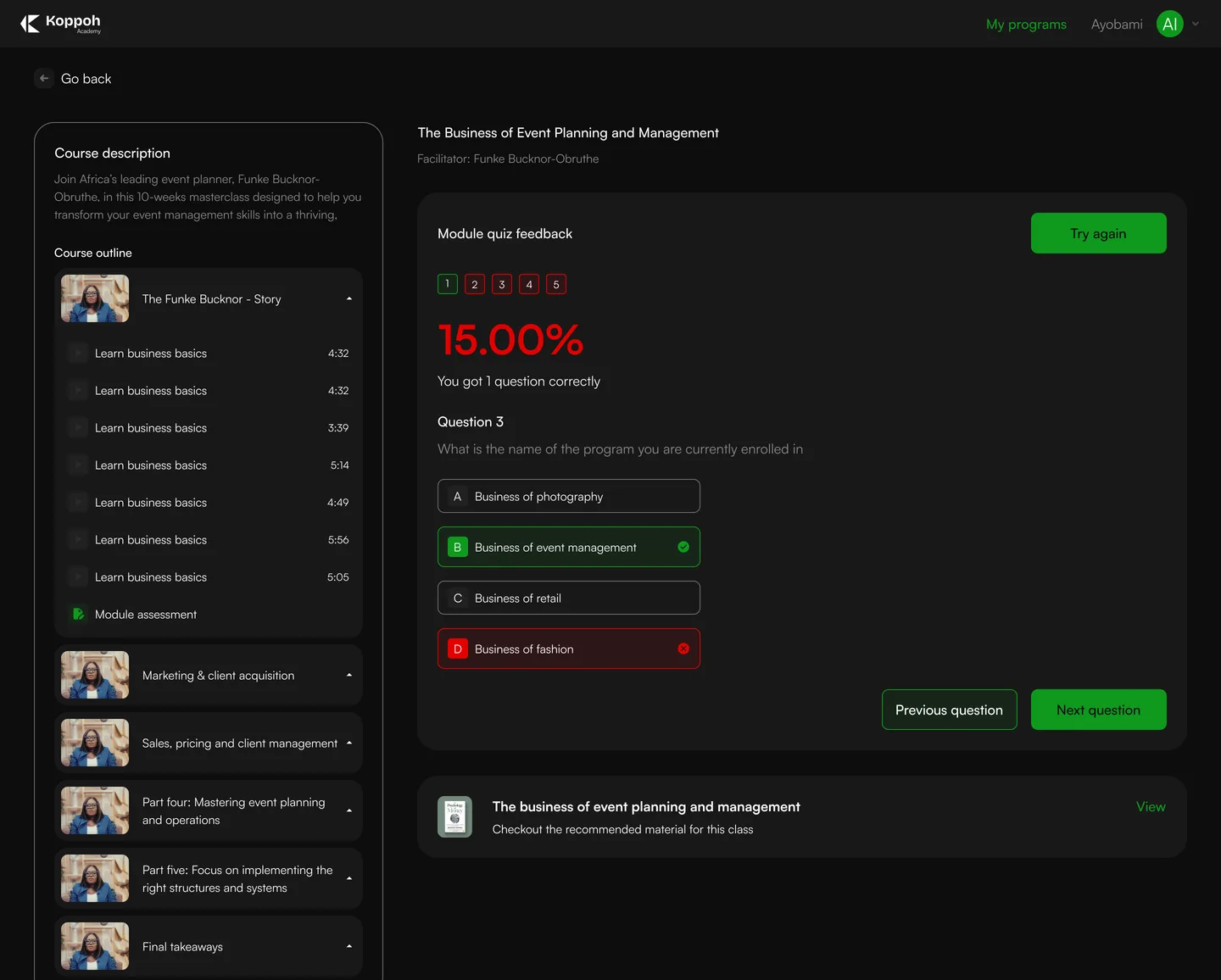
I worked on the experience for module quizzes, final assessments, and certificate access, translating the programme rules into understandable learner-facing states.
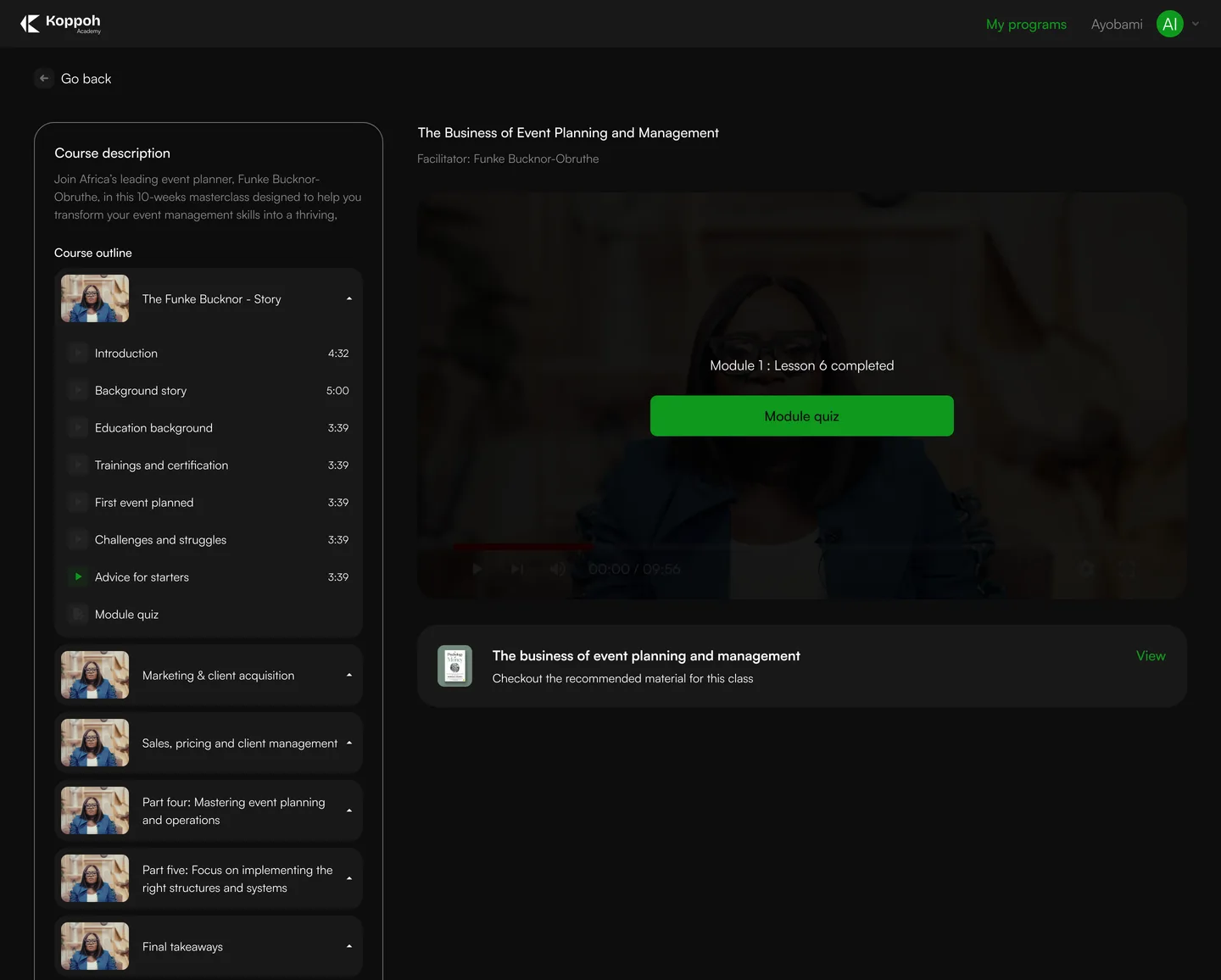
Step 1 of 17The module's lessons done: its quiz is next
Module quizzes
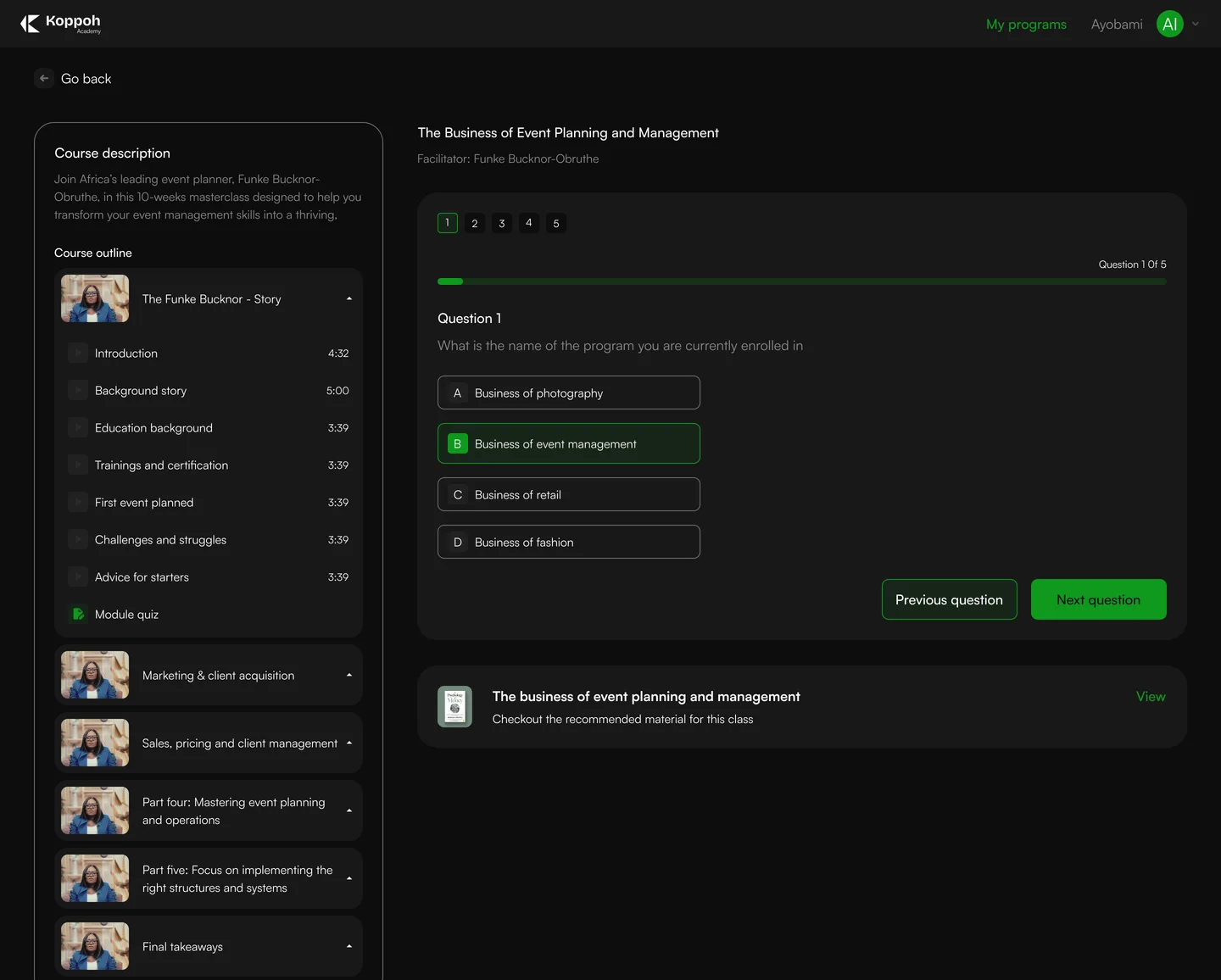
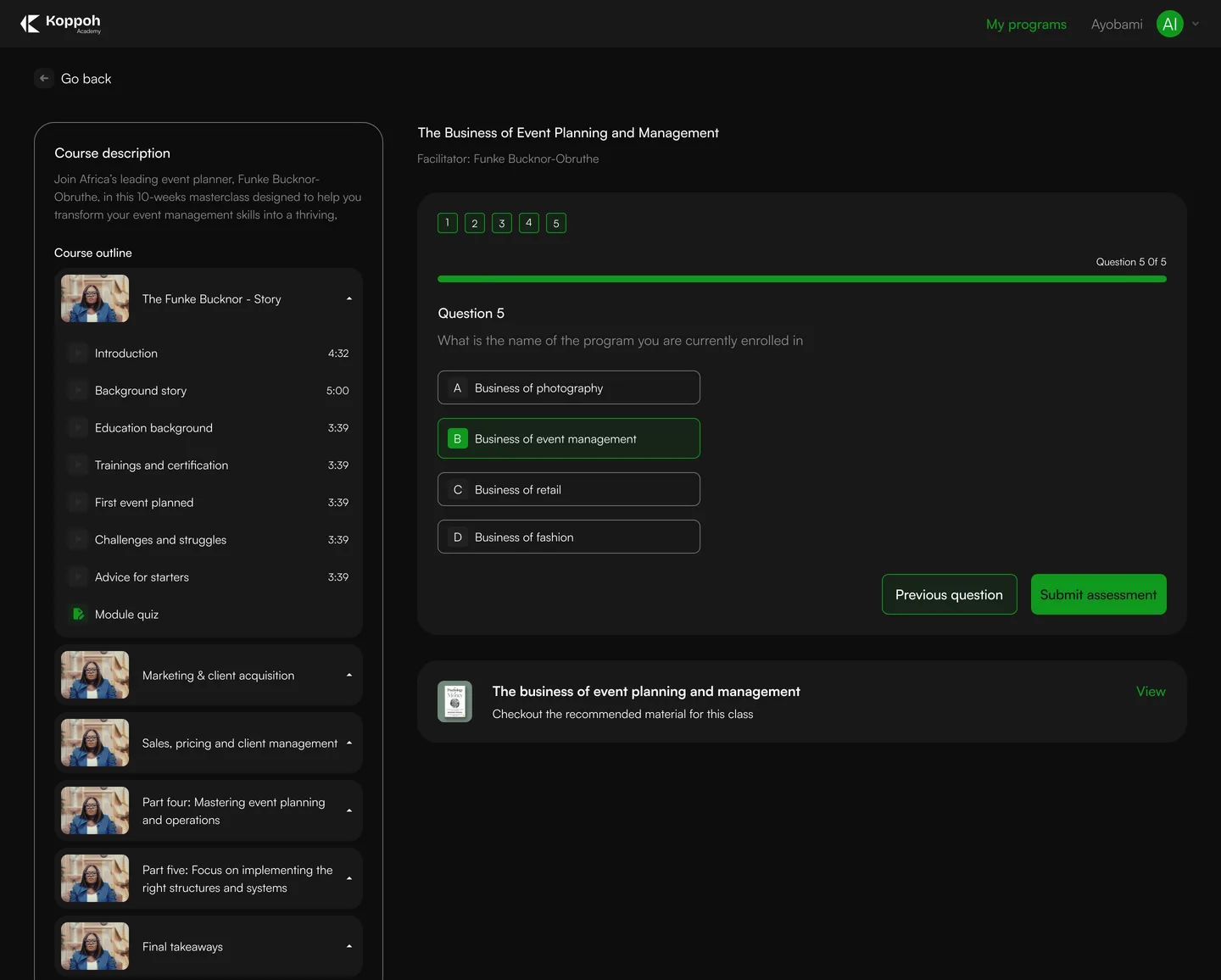
Each module included a quiz following its lessons.
The quizzes provided learners with scores, giving them feedback on their performance as they moved through the programme. These scores did not contribute to the final assessment score.
Keeping the quizzes distinct from the final assessment reflected their role in the learning journey: they were checkpoints within the modules, rather than the final measure used to determine certification eligibility.
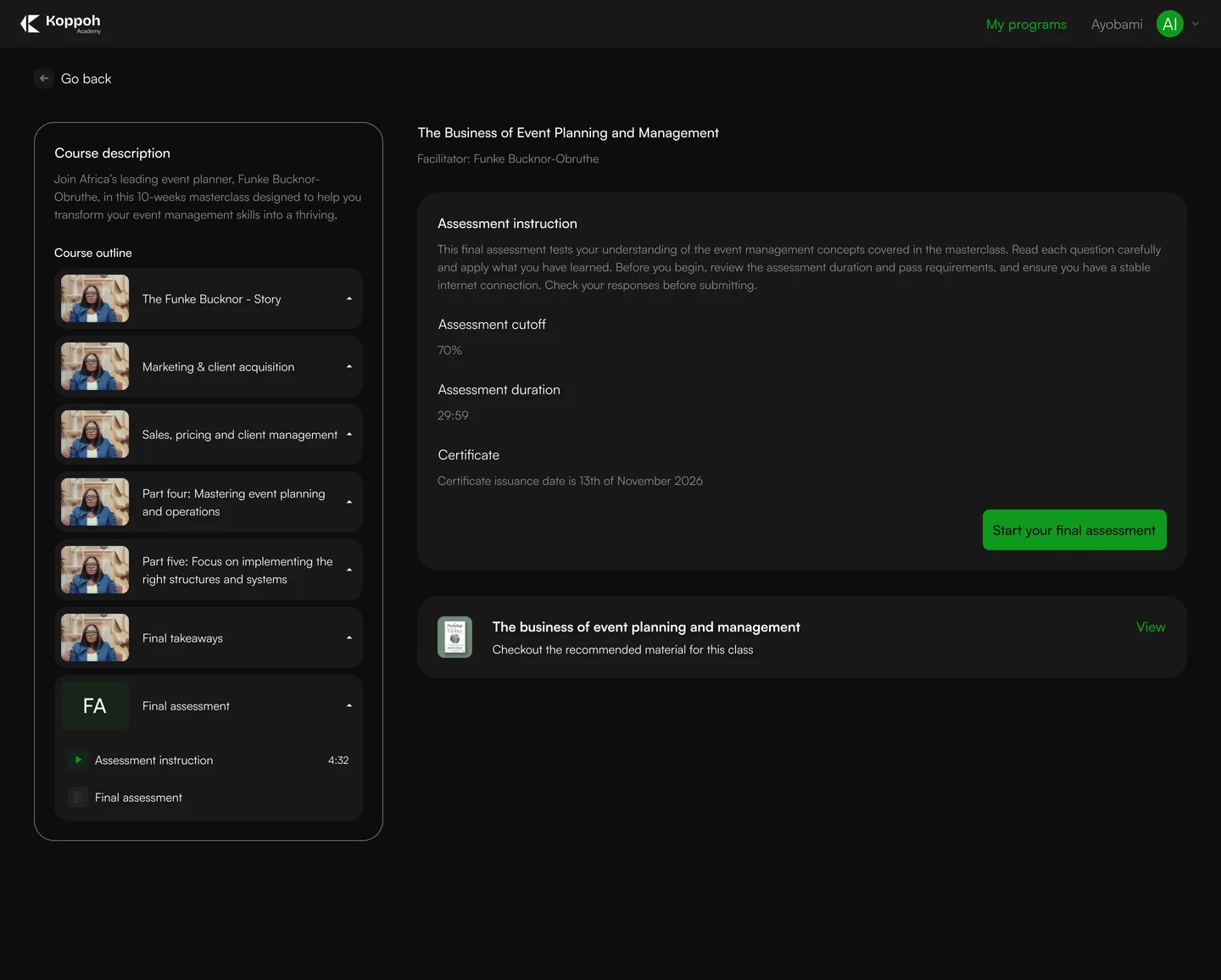
Final assessment
The final assessment followed a different set of rules.
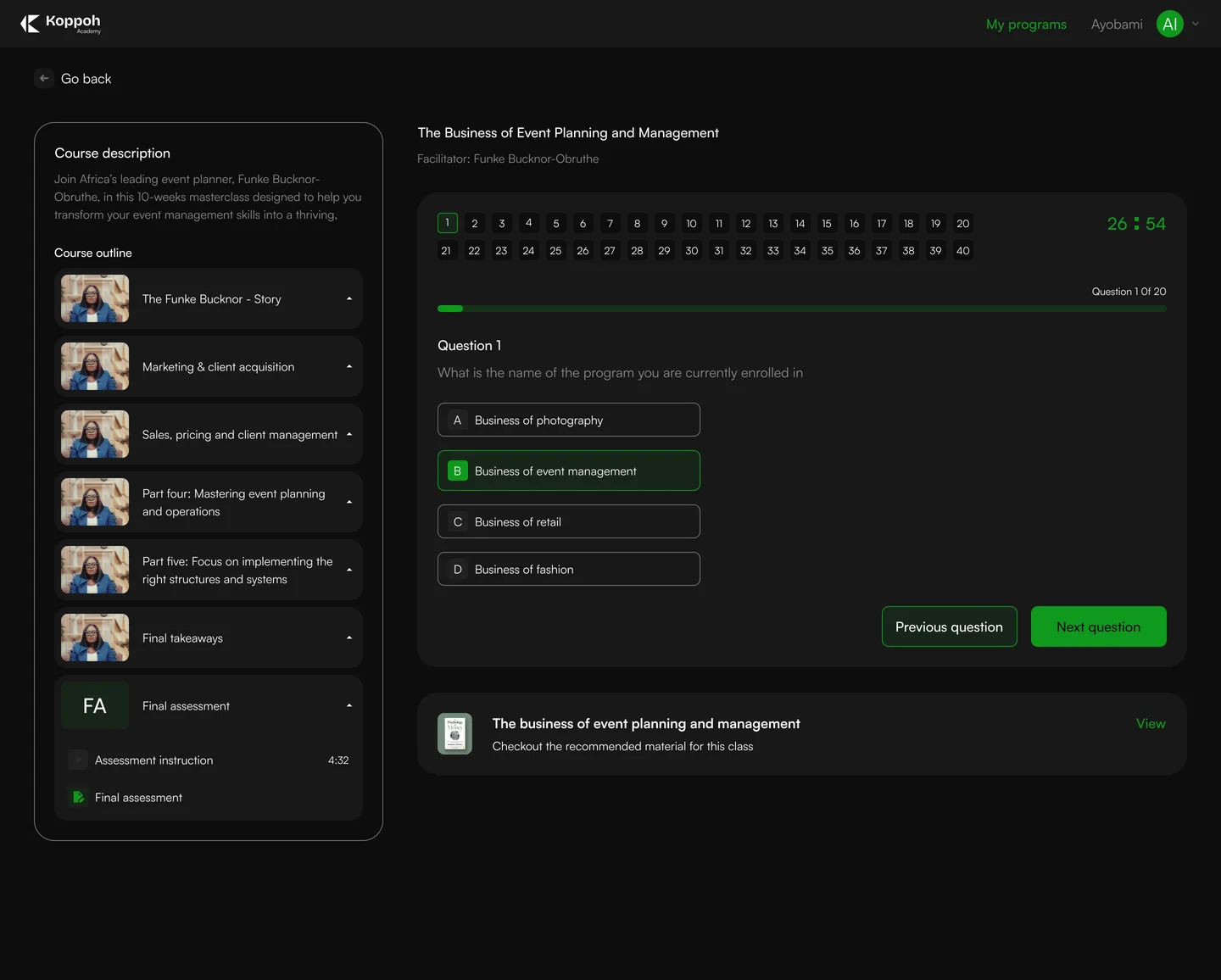
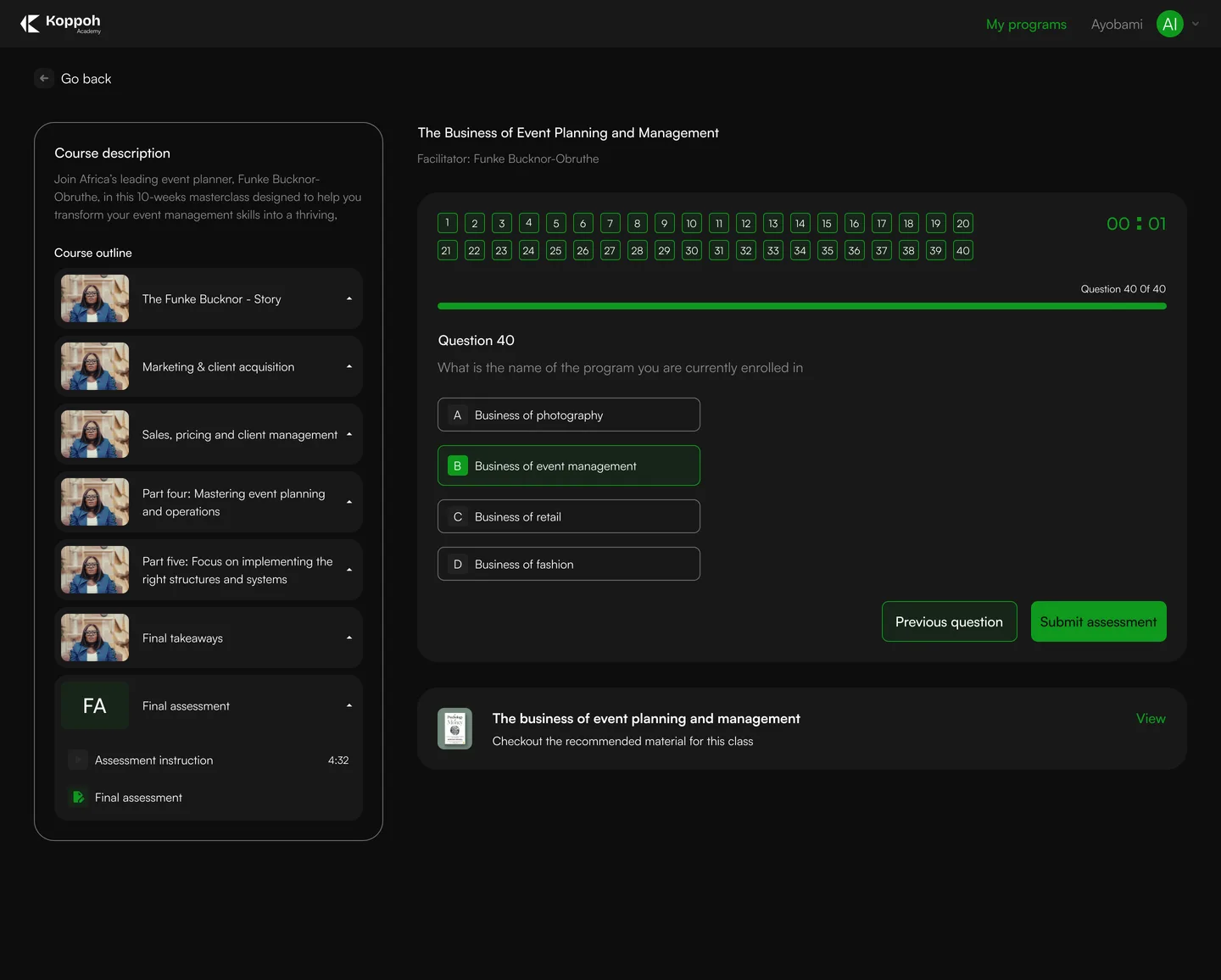
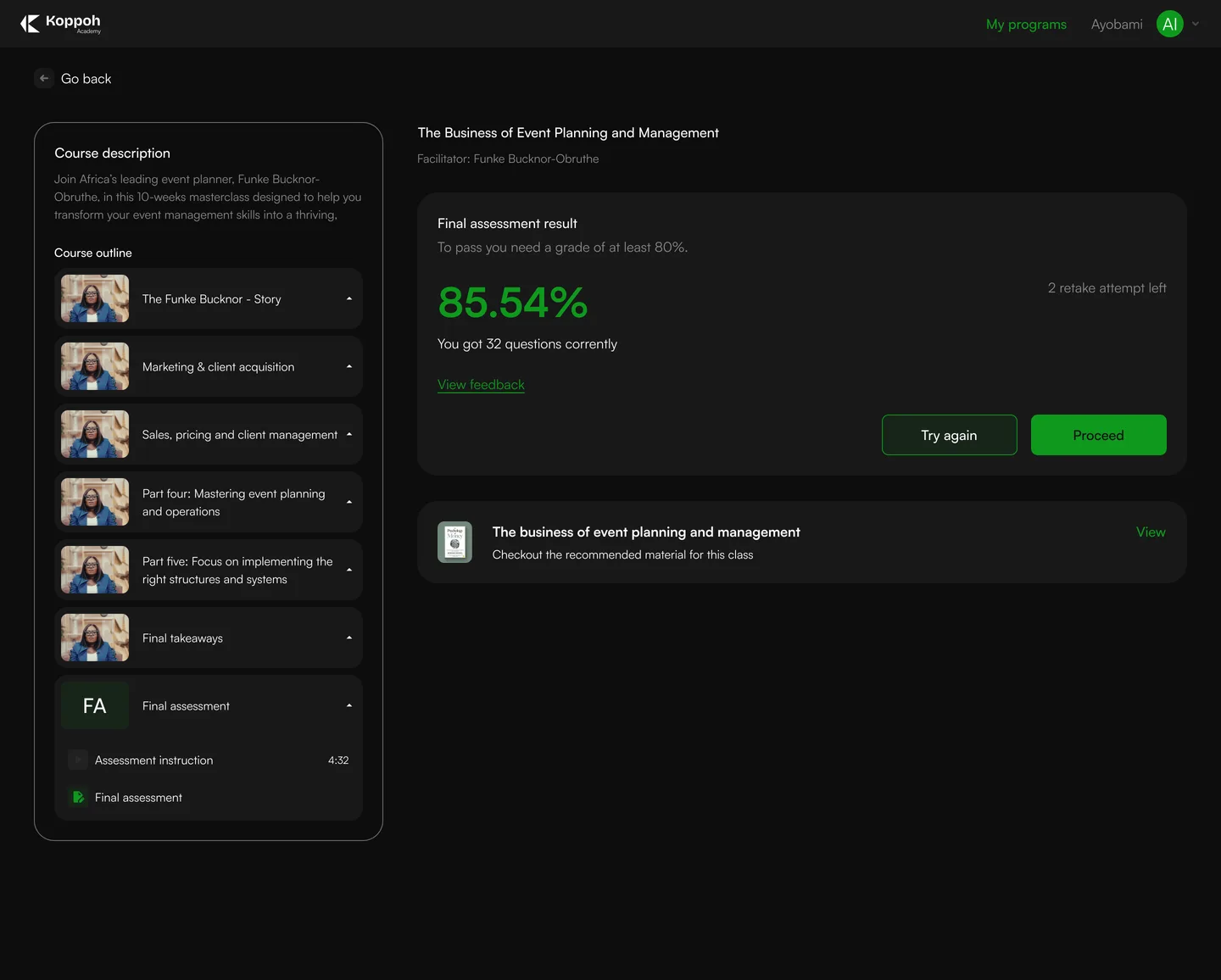
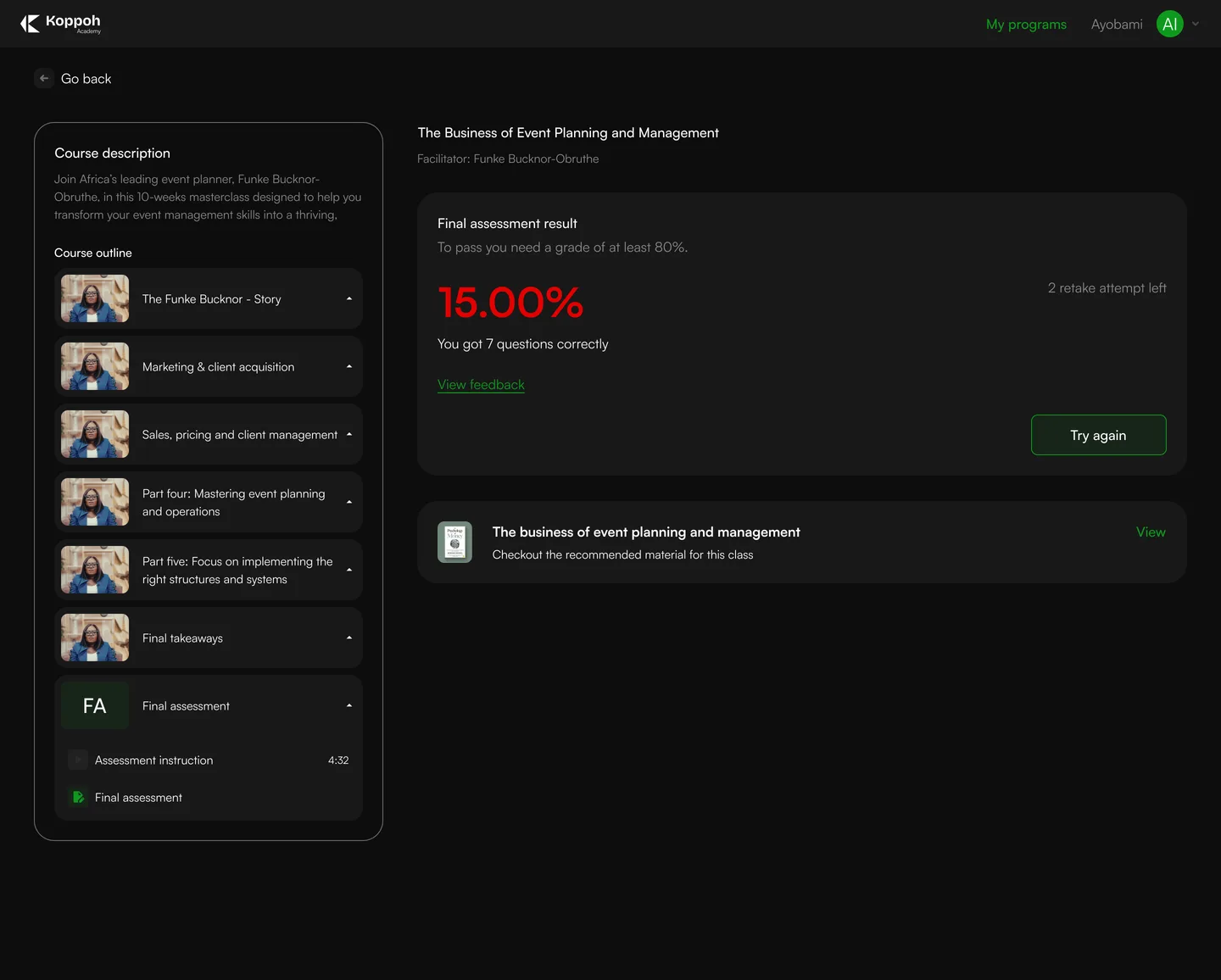
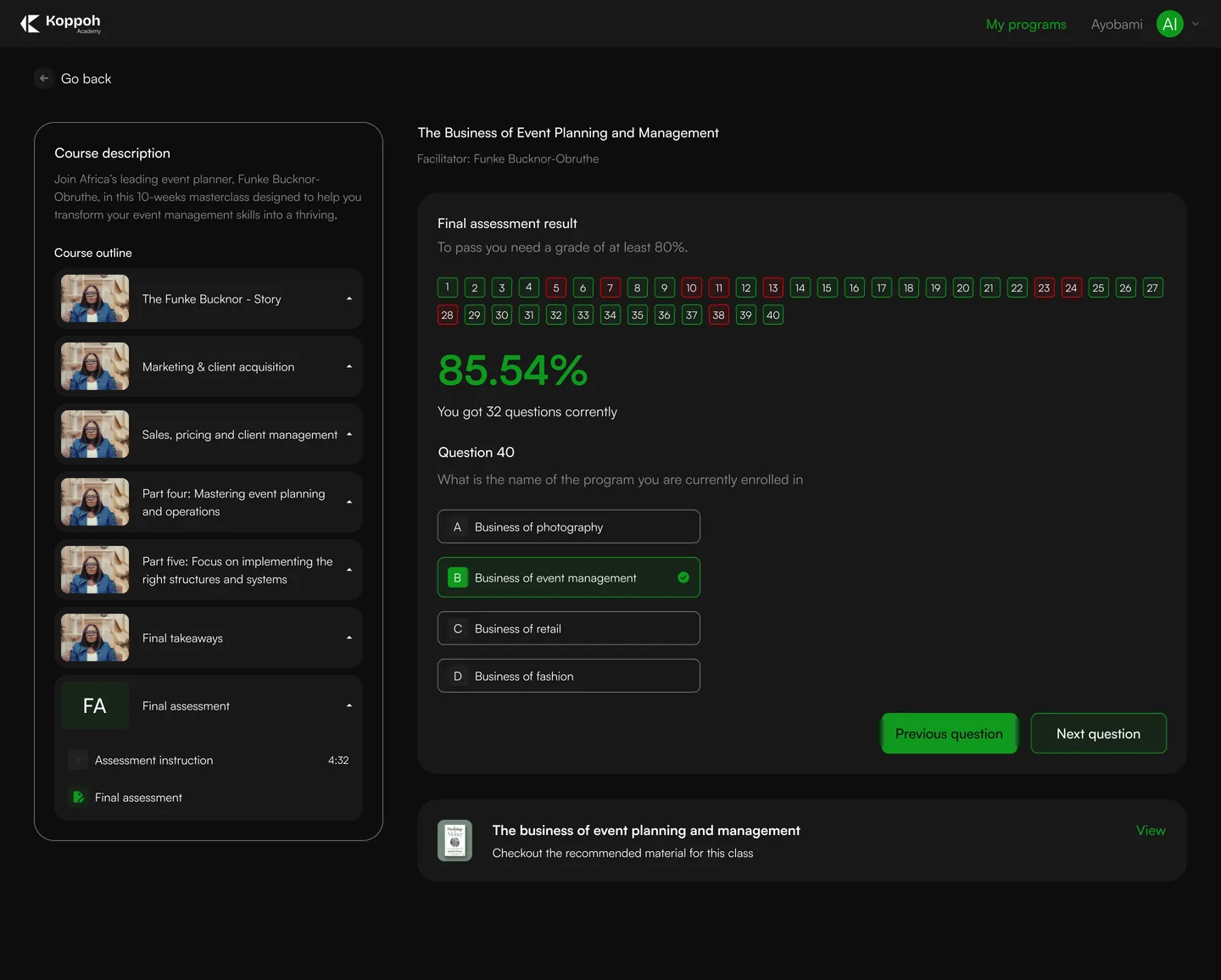
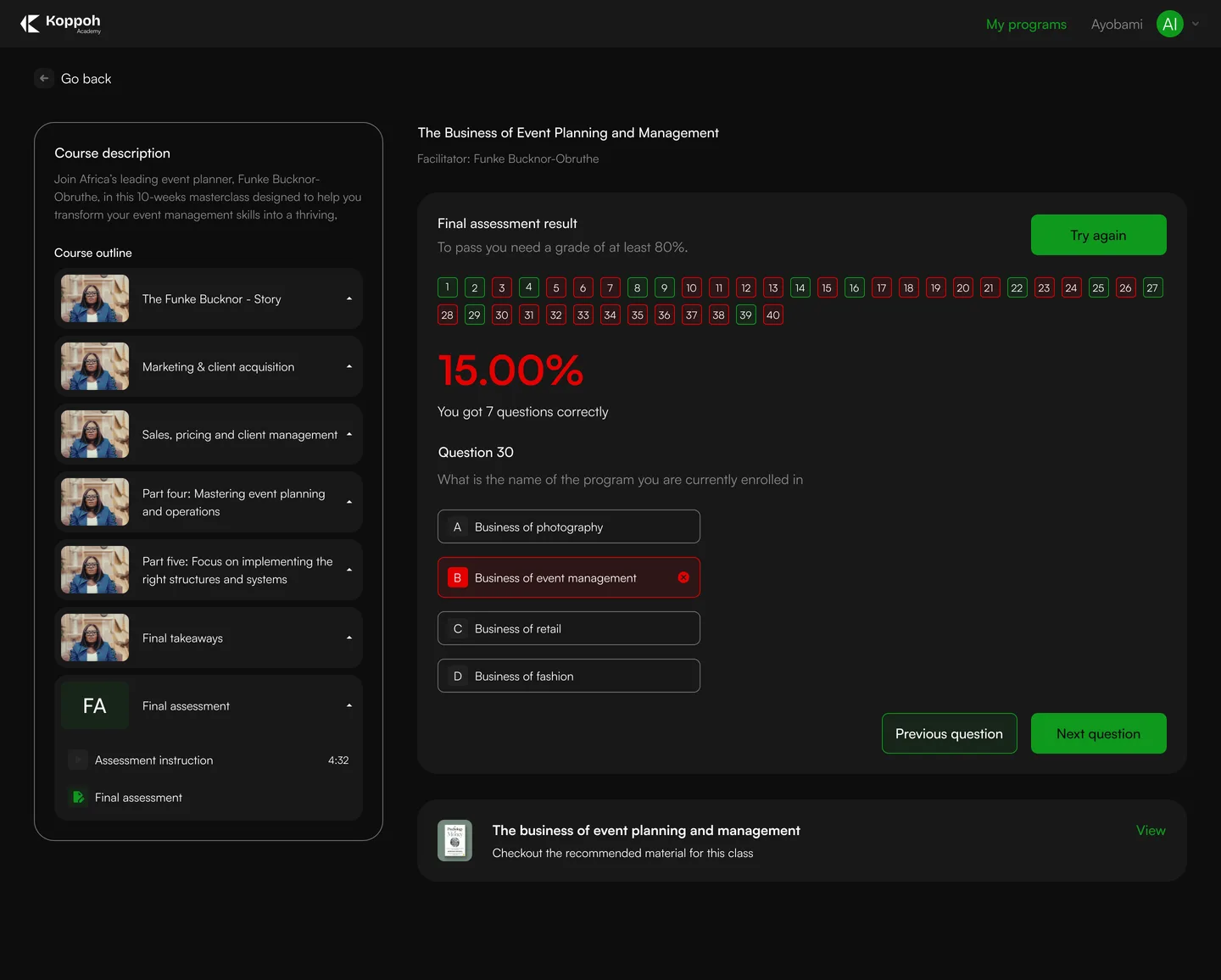
It was available only within a scheduled assessment window, with defined opening and closing dates. Learners had to complete the required modules before the final assessment became available.
Learners could attempt the assessment up to three times within the allowed window. This gave those who did not pass an initial opportunity to try again, while preserving the programme's assessment schedule.
The interface needed to communicate these conditions so learners could understand when they were eligible to take the assessment and what their available options were.
Certificate eligibility and release
Certificate access was also tied to specific programme conditions.
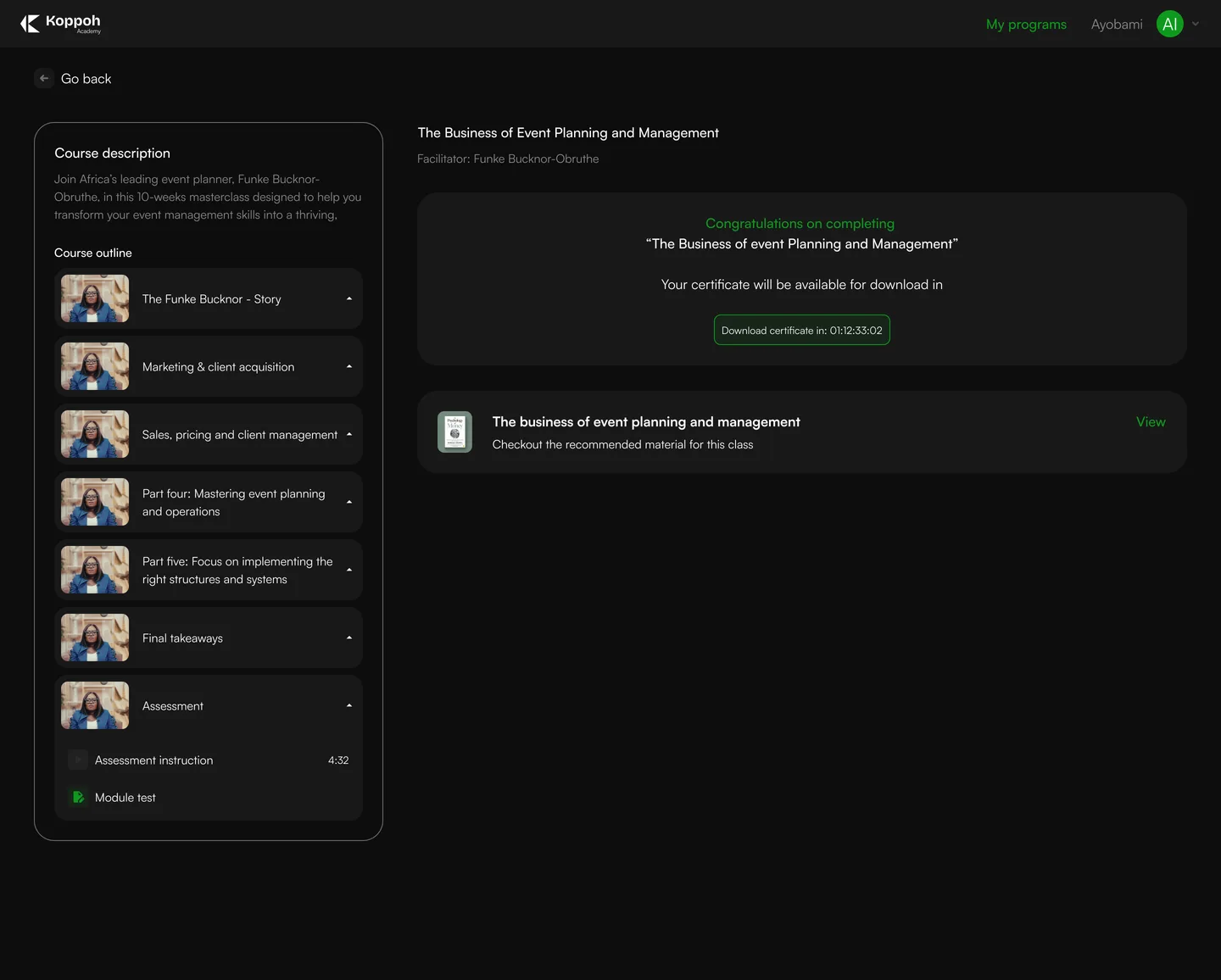
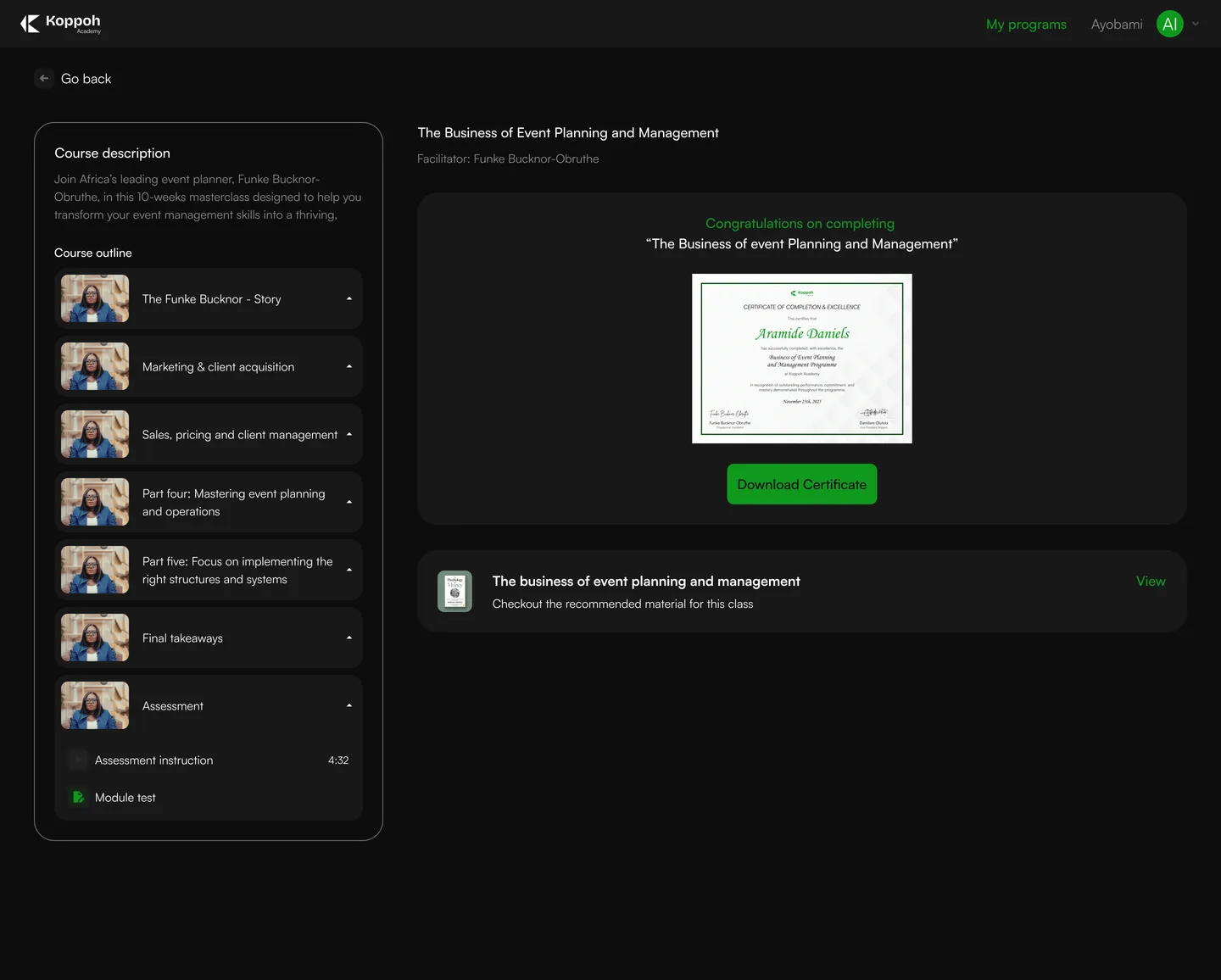
Learners needed to pass the final assessment, and certificates became downloadable after the assessment window closed.
This meant a learner who passed early could not immediately download their certificate while other learners were still within the scheduled assessment period.
The rule supported a coordinated cohort completion process. The design needed to make this restriction understandable by distinguishing between passing the assessment and the point at which the certificate became available.
Together, the quiz, assessment, and certification experiences established a progression from participating in the programme to meeting its completion requirements.
Working across product, engineering and operations
The work required collaboration because the learner experience depended on business rules, technical implementation, and ongoing learner support.
I worked with the Product Manager to clarify requirements and translate them into flows and screens. This was especially important where decisions about payment, lesson availability, assessment windows, and certificate release affected multiple stages of the learner journey.
Before designing the payment experience, I spoke with engineers to understand the existing payment infrastructure and how the proposed flow could fit into it. This helped ground the design in the system's implementation realities.
Customer Success contributed insights from conversations with prospective and enrolled learners. Their feedback helped the team understand where learners were experiencing barriers and informed the introduction of instalment payments.
I also took responsibility for much of the functional testing because the team did not have a dedicated QA resource for this work. The Product Manager tested the experience as well, and a number of issues were fixed before or around launch.
This testing focused on whether the implemented experience behaved as intended across the relevant flows and states. It was not a formal usability research study, so I would not describe it as one.
The product remains live and continues to evolve. The work was therefore not a single redesign with a fixed endpoint, but an ongoing process of translating new requirements and learner needs into improvements to the existing experience.
Outcomes and impact
Koppoh Academy moved the business beyond its original fundraising proposition and created a platform through which entrepreneurs could access structured, expert-led business education.
The learner-facing work supported that direction by connecting enrolment, payment, scheduled learning, assessment, and certification in one experience.
The impact can be understood across several areas.
A broader path into paid programmes
Introducing full payment, two-instalment, and three-instalment options gave prospective learners more flexibility in how they paid for a programme.
The team observed better learner uptake after instalments were introduced and previously interested prospects were re-engaged. This was an encouraging signal that the payment model was addressing a real barrier, although the team did not establish a quantified conversion uplift.
A more self-service enrolment experience
Payment verification and automated communications reduced the need to coordinate every enrolment step manually. Learners could receive payment confirmations, understand upcoming instalments, and return to complete outstanding payments through the platform's payment flow.
This created a clearer process for learners and a more structured approach to payment follow-up. The extent of any reduction in operational workload was not formally measured.
A structured digital learning experience
Learners could access their programmes through a consistent journey, from the dashboard to modules, lessons, quizzes, final assessments, and certificates.
The experience reflected the cohort model through scheduled programme starts, controlled lesson releases, assessment windows, and defined certificate eligibility.
Early business traction
The first event-planning programme, featuring Funke Bucknor-Obruthe of Zapphaire Events, reportedly generated approximately ₦20 million in revenue over its first three months, with around 50 or more learners associated with the programme.
These figures were reported as programme outcomes rather than independently audited results. They demonstrate early commercial traction for the academy, but they should not be interpreted as revenue generated by design alone.
The programme also offered learners exposure to an experienced industry practitioner. Some learners had the opportunity to accompany the facilitator to events and observe her work, extending the learning experience beyond the platform itself.
A photography programme followed, with a younger audience and a different affordability profile. It was still running at the time of this case study, so its final outcomes were not yet known.
Across the work, the team estimated that more than 100 people had used the platform. This is an approximate figure rather than a verified analytics total.
Understanding the limits of the evidence
The strongest evidence available at this stage is the live delivery of the experience, the observed response to instalment payments, and the reported commercial traction of the first programme.
The team did not have verified before-and-after conversion figures, detailed payment-completion metrics, or a formal study establishing how the design affected learning outcomes. I would want to collect those measures before making stronger claims about the product's impact.
What I learned
Koppoh Academy moved the business beyond its original fundraising proposition and created a platform through which entrepreneurs could access structured, expert-led business education.
The learner-facing work supported that direction by connecting enrolment, payment, scheduled learning, assessment, and certification in one experience.
The impact can be understood across several areas.
Accessibility is more than reducing the initial price
A more accessible payment option is only useful when learners understand the commitment they are making. Transparency and predictability are part of accessibility, not details to add after the payment model has been decided.
Product rules are part of the user experience
Cohort dates, lesson locks, assessment windows, and certificate release rules could easily have been treated as backend requirements.
However, each rule influenced what learners saw, what they could do, and how they understood their progress. Designing the interface meant making those rules visible and understandable.
This reinforced the importance of designing not only screens, but also the states, conditions, and transitions that connect them.
Business goals and learner needs need to be designed together
Koppoh needed to preserve a structured cohort model while making education more accessible. Learners needed flexibility and clarity, while the business needed predictable programme delivery and payment control.
The solution was not to optimise exclusively for either side. It was to create an experience that respected the programme structure while making enrolment and progression easier to understand.
What I would explore next
One opportunity I would explore is offering shorter, lower-cost learning experiences, such as individual modules or short-form courses.
These would not replace the existing cohort model. Instead, they could provide a lower-commitment entry point for learners who want to build a specific skill or explore a subject before investing in a more comprehensive programme.
A potential journey might allow a learner to begin with an affordable short course, build confidence in the platform and its facilitators, and later enrol in a premium cohort programme.
This remains a hypothesis to validate, not a feature that has already been built. Before committing to it, I would want to investigate learners' willingness to pay, the subjects they would value most, the operational implications for content delivery, and whether the model would complement or compete with the existing programmes.
I would also explore how learning analytics could help the team identify where learners struggle, what content they engage with, and whether assessment and completion patterns reveal opportunities to improve the experience.
The broader opportunity is to make practical business education accessible at different stages of an entrepreneur's journey, without losing the value of learning directly from experienced practitioners.